

4.8
Coast to Coast Traverse of Bali
This unique trek – dubbed 'Indonesia's Camino' – takes you far from the crowds, through the lush landscapes of this tropical island paradise
10nights
Level 3
14max group
Why you'll love it
Hike south to north through the island's heart, via dense jungle, lush rice paddies, cocoa and coffee fields, and little-visited villages
Wander through lush green landscapes to reach majestic waterfalls like Dedari, Cemara, and stunning Aling Aling for dreamy swims
Explore beyond the beaches and soak up Bali’s rich culture, glimpsing local village life in the highlands, and enjoying delicious Indonesian food throughout the trip
What's Included?
- Activities & Certified Guides
- Lodging & Camping
- Meals10 breakfasts, 8 lunches, 6 dinners
- TransfersTo and from the airport and everything in between, including a support vehicle through the trip
- GearAll your camping gear, plus headlamp and trekking poles
- Maximum group size: 14
Itinerary
Day 1
Welcome to Bali
HotelTwin shareDinner includedShow Day 1 detailHide detail
Touch down in Bali and meet your host at the airport before being whisked off to your beachside accommodation in Tabanan, located on the south coast of the island. Settle into this tranquil spot and start soaking up the laid-back vibe in this part of the world, maybe walking along Batu Tampih Beach or just chilling by the pool right by the shore. Meet up with your host and fellow adventurers for a welcome dinner this evening, tucking into classic Indonesian dishes and having a chat about the epic adventure ahead (opens in new tab).
Day 2
The trek begins
Hiking4-5hrs · 8mi · 459ft up · 164ft downBoutique HotelTwin shareBreakfast and lunch includedShow Day 2 detailHide detail
Take a morning dip in the sea and fuel up with a big breakfast before the trek begins, setting off right from the resort - passing through the village of Tibubiu and continuing along a riverside, following small village and farming tracks past rice fields. The going is easy today to warm you up for the longer days to come, with about 3 hours to get through along relatively easy terrain, stopping for a local picnic lunch under trees with views of the surrounding rice fields. Today's trek winds up at Umadhatu Resort where you can relax in the gardens and by the pool after your first day of trekking.
Day 3
Megati village to Kemetug
Hiking4-5hrs · 8mi · 820ft up · 164ft downMountain RetreatTwin shareBreakfast and lunch includedShow Day 3 detailHide detail
Wake up to reveal the lush green surroundings and enjoy Indonesian coffee, settling into the rhythm of life on this unique trail. You're surrounded in this part of Bali by a tapestry of cacao, coffee, exotic fruit plantations and beautiful rice paddies, with volcanic peaks in the distance. Pick up the trail straight from the hotel, meandering through rice paddies and coffee plantations and witnessing farmers tending their crops in the same way that has been practiced here for thousands of years. Bunk down at a mountain retreat tonight for more Indonesian hospitality.
Day 4
Kemetug to Kampung Kopi
Hiking6-7hrs · 10mi · 656ft up · 656ft downCampsiteTwin tentAll meals includedShow Day 4 detailHide detail
Set off again straight after breakfast along a rural road and on to a trail through the local plantations of coffee and cacao, passing families tending gardens of fruits and glimpses of local life. See the local temple here and enjoy lunch in the village gardens. Continue on your hike in the afternoon, crossing a river to reach Karyasari village and further following a path on the edge of the water flow to arrive at some of the most beautiful rice terraces on the island. Tonight you'll be bunking down under canvas at a community-run campground in lush green surroundings.
Day 5
Through the jungle from Pupuan to Bengkel Village
Hiking5-6hrs · 9mi · 656ft up · 820ft downMountain RetreatTwin shareAll meals includedShow Day 5 detailHide detail
You're now entering the northern section of the coast-to-coast trail through Bali, an area of vibrant jungle and rainforests that stretch to the coast. Trek along varied trails today from Papuan to Bengkel, stopping on the way at Blamantung waterfall which crashes 325 ft down from above, creating an inviting pool for a dreamy open water swim. You're in dense, humid jungle for most of today and the conditions can get hot and sticky, making an idyllic waterfall swim all the more refreshing. The remoteness of this spot is in complete contrast to the side of Bali most visitors experience. You'll be trekking through the morning and early part of the afternoon, eventually reaching a lovely mountain-top resort hidden away amidst the forests. Enjoy some downtime here, soaking in the pool and taking in the 360-degree views from the rooftop bar.
Day 6
Rest day in a beautiful part of Bali
Yoga1hrMountain RetreatTwin shareAll meals includedShow Day 6 detailHide detail
Take a break from hiking and enjoy a free day today. Your host will arrange a yoga class among the stunning landscapes here to stretch out tired legs and help you relax into the rest day. There's a beautiful pool here overlooking the forested hillsides which you can enjoy as much as you wish. After lunch you can explore nearby villages and waterfalls, or simply unwind at your accommodation to recharge before continuing your adventure tomorrow.
Day 7
Bengkel to Bedugul Village via Tamblingan Lake
Hiking5hrs · 9mi · 2198ft up · 1017ft downBoutique HotelTwin shareAll meals includedShow Day 7 detailHide detail
It's time to continue the journey again after your relaxed day yesterday. Start trekking straight from your mountain retreat of the past two nights, at a higher elevation of around 2,950 ft in this area through coffee fields. Hike through a village footpath mixed with dirt roads then continue with a beautiful backdrop of wildflowers, with Lesung mountain looking on the left. Descend down through the coffee plantation and take in the view over Tamblingan lake before hiking down to and around the lake, stopping at Pande temple before the final stretch of hiking back in the tropical jungle again to reach tonight's hotel stopover.
Day 8
Chasing waterfalls
Hiking6hrs · 9mi · 164ft up · 3346ft downBoutique HotelTwin shareAll meals includedShow Day 8 detailHide detail
Today involves a lot of descent through Bali's secluded and scenic highlands on a route where you'll find authentic villages such as Wanagiri, rarely seen by travelers. Descend past emerald green rice terraces and local farms before heading deep into the forest. Here, you'll discover some of the island’s most spectacular waterfalls: Cemara and Dedari, surrounded by lush trees and exotic flowers. Enjoy some time at the waterfall and grab an open water swim in the refreshing waters before settling in for lunch at this beautiful spot. After lunch you'll continue hiking along the river and rice fields towards Aling-Aling Waterfall, another absolute highlight of the Bali coast to coast route.
Day 9
Sambangan to the finish line
Hiking3-4hrs · 6mi · 328ft downBeach RetreatTwin shareBreakfast and lunch includedShow Day 9 detailHide detail
The adventure builds to a conclusion as you tackle the final section with an easy walk to reach the coast. You are heading to Penimbangan Beach, hiking through villages with the sea getting ever closer in sight. Arriving on the beach, your mission is complete, so dive in for a ceremonial swim to mark the moment – you've officially trekked across Bali from coast to coast! A vehicle will later whisk you down the coast to Lovina, a beautiful spot to soak up some beach time and grab some sundowners to toast the completion of an epic trek along Bali's own 'camino'.
Day 10
Return to the South
Driving4hrsBeach RetreatTwin shareBreakfast includedShow Day 10 detailHide detail
Enjoy a leisurely breakfast at the hotel, keeping an eye on the water – Lovina's population of dolphins may make an appearance. Settle into the van for a scenic road trip back down south through the highlands, stopping at a local restaurant in the Bedugul area. Continue on to Sanur with a stop at Taman Ayun Temple in Mengwi, the second largest temple in Bali. Arriving in the Sanur area of south Bali you'll check into your final hotel of the trip. The rest of the day is yours to relax as you wish – there is a spa available here if you want to relieve your tired trekkers' legs with a massage later this afternoon. In the evening the group will have a celebratory dinner, enjoying one last feast of Indonesian food and reminiscing about an epic adventure.
Day 11
Farewell, Bali
Breakfast includedShow Day 11 detailHide detail
Enjoy one last tropical breakfast before your transfer to the airport in time for your return flight home.
Where You'll Stay
Looking for a private room? See Optional Extras for details and pricing.

Beach resorts at the start and end of the tour
Your first night of the trip is spent at Amarta Beach Retreat, a luxurious retreat in the relaxed area of Tabanan on Bali's south coast. The resort is a great place to relax after your journey to reach Bali with its beachside pool, and Sawang Beach is right next to the accommodation. You'll stay in twin-share rooms with private bathrooms. And then, after driving back through Bali to the south coast on Day 10, you'll spend a final afternoon and evening at Parigata Resorts and Spa, located on Sanur's beachfront. There is an outdoor pool, plus spa facilities and massages available if you want to treat yourself after nine days of solid trekking. At both hotels, you'll stay in twin-share rooms with private bathrooms.

Antagana Retreat
Nestled among lush greenery, Antagana Retreat offers a peaceful escape after your first day of hiking. You'll stay in cozy twin-share rooms designed to blend with the surrounding natural beauty, and en suite bathrooms.

Bali Mountain Retreat
On day 3 you'll stay at Bali Mountain Retreat, perched on the slopes of Mount Batukaru - an ideal location to unwind in cool mountain air. You'll spend a restful night here on day 3 in twin-share rooms with en suite bathrooms, surrounded by jungle and rice terraces.

Kampung Kopi campground
On Day 4, you'll bunk down in tents at a community campground nestled in a beautiful spot at Kampung Kopi Camp. You'll stay in twin-share tents with shared bathroom facilities. Tents with sleeping mats, pillows and sleeping bags are provided.

Atres Sari Hotel or Villa Ipsa
Atres Sari Hotel and Villa Ipsa blend Balinese charm with modern comforts, set among rice paddies and coconut trees. You'll spend two nights here in the middle of the trip, including your rest day on day 6. You will stay in twin-share rooms that open onto gardens with views of the tranquil rural scenery. Nestled in the peaceful highlands of North Bali, the lodging here invites you to experience the authentic rhythm of Balinese village life, surrounded by green valleys, rice terraces, and cool mountain air.

Garuda Hotel
Another welcoming stop on your journey on foot across Bali, the Garuda Hotel offers friendly hospitality and a convenient location. Comfortable twin-share rooms with en suite bathrooms ensure a good night’s rest.

Maha Hills Resort
Shanti Natural Panorama lives up to its name, with panoramic views over the lush hillsides all around this gem of a lodging on day 8 as you approach the finish line of your coast to coast traverse. You'll stay in twin-share rooms with an en suite bathroom.

Lovina Haven Boutique Resort
After completing your traverse and reaching Bali's north coast, you'll celebrate and spend a night at Lovina Haven Boutique Resort. Set right by the black-sand shores of Lovina, Sunari Beach Resort is the perfect place to end the adventure. You will stay in twin-share rooms with en suite bathrooms and enjoy stunning sunsets over the Bali Sea.
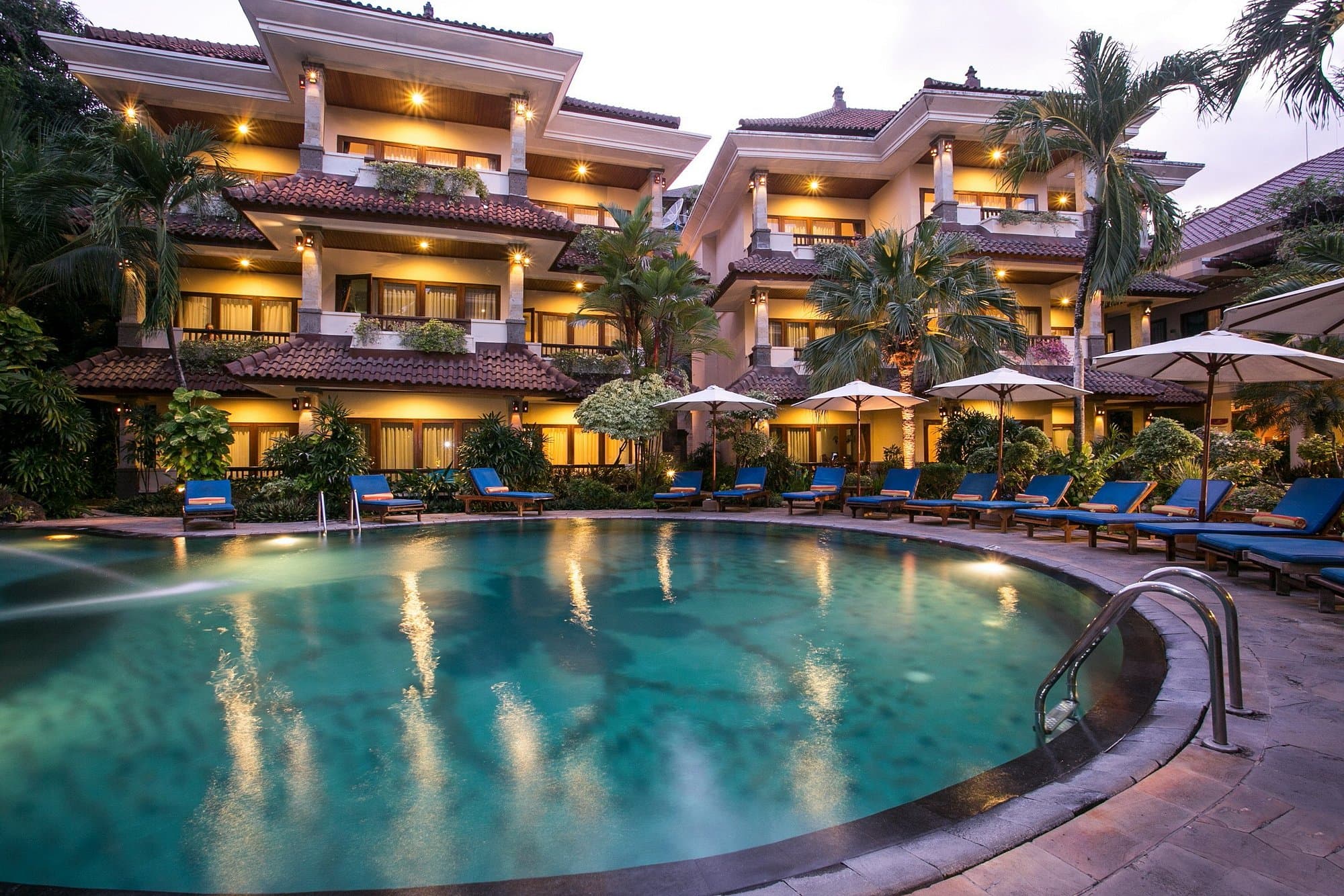
Sanur
After driving back through Bali to the south coast on Day 10, you'll spend a final afternoon and evening at Parigata Resorts and Spa, located on Sanur's beachfront. There is the obligatory outdoor swimming pool, plus spa facilities and massages available if you want to treat yourself after nine days of solid trekking. You'll stay in twin-share rooms with en suite bathrooms.
What You'll Eat
Indonesian food varies greatly by region, but there is one thing you can always depend on finding: rice. Expect to eat a range of curries, noodle dishes, and soups along the route, at various small-scale local restaurants selected by your host, as well as certain meals taken at that day's accommodation. Breakfasts at the hotels will vary from banana or pineapple pancakes to omelets, fried or boiled eggs, pisang goreng (fried sweet banana), and fruit salads. Lunches and dinners may include dishes such as mie kuah (noodle soup with vegetables and…
Dates & prices
Secure your spot
10% deposit to bookLimited exceptions
Pay in instalmentsNo interest or fees
Free cancellationOn most trips, up to 65 days before departure
Don’t see a date you like?
Get an email alert when new dates are added for this trip.
Subscribe to alertsWhat is and isn't Included?
What's included
- Guided hike from Tabanan to Megati
- Guided hike from Megati to Kemetug
- Guided hike from Kemetug to Belimbing
- Guided hike from Belimbing to Wana Sepi Munduk Asah
- Guided hike from Papuan to Bengkel, via Blamantung waterfall
- Guided hike from Bengkel to Bedugul village
- Guided hike to finish point at Penimbangan Beach, via Dedari, Cemara and Aling Aling waterfalls
- Expert, local, English-speaking trekking guides
- 1 night camping at a community-run campground
- 3 nights at boutique beach retreats either end of your traverse
- 6 nights at mountain retreats and boutique hotels along the route
- All (10) delicious breakfasts
- 8 lunches
- 6 Indonesian dinners
- Arrival transfer from Denpasar Airport any time on Day 1
- Departure transfer to Denpasar Airport any time on Day 11
- All transfers during the trip
- All your camping gear, plus headlamp and trekking poles
- All permits and fees
What's not included
Our trips do not include flights, trains or other travel to the start point and back from the end point.
Tips are not included in the trip cost. These are entirely at your discretion but there is an expectation to tip for good service. Your guide will help with advice, however we suggest the below as a guideline:
- $2-3 USD per person, per day for your guide
Of course, you are free to tip more or less, and the amount should be reflective of your perception of service and quality. A tip is not compulsory and should only be given when you receive excellent service.
Travel insurance is compulsory for all of our adventures, and you'll need to provide your policy details before departure. Your insurance should offer adequate cover for overseas medical treatment, evacuation/repatriation, your baggage and equipment, and the specific activities involved in your adventure. We also recommend ensuring your policy includes cancellation and curtailment cover, in case you're unable to join your trip due to unforeseen circumstances such as illness.
Standard travel insurance may not cover all the activities included in your adventure, so it's essential to check the details carefully. There are adventure-specific providers that many travelers have used in the past, such as True Traveller (opens in new tab) (for those based in the UK or Europe), or Rise + Shield (opens in new tab), both of which offer cover for a wide range of adventurous activities.
Please make sure your chosen policy meets your individual needs and covers all aspects of your trip.
Visa requirements often change, and you are responsible for obtaining any required visas for this trip. Please check with your nearest embassy or consulate for up-to-date advice.
You know your own spending habits best, so please budget an appropriate amount for things like optional meals and drinks, shopping, optional activities, and laundry.
Optional Extras
For solo travellers wanting their own space, you can request a solo room upgrade for majority of this trip. Please note that solo tents are not available at the community campsite on Day 4. Please request on booking, as this is subject to availability. See Optional Extras for prices.
Solo Upgrade
- Solo room upgrade
- Covers both the room nights and the camping nights
- $572 pp
- Apr 23, 2027 – Oct 25, 2027
- $616 pp
- Apr 21, 2028 – Oct 23, 2028
We've Got Your Back
Book with confidence and peace of mind.
Ratings & Reviews
4.850 reviews
- 2 stars (0)
- 1 star (0)
Category rating
- Food
- 4.0
- Guides & crew
- 5.0
- Accommodation
- 4.0
- Itinerary
- 5.0
Latest Reviews
Laith
I feel privileged to have been able to experience a hidden Bali that often only local people get to see. Away from the resorts and tourist traps and stomping grounds. Life here moves to an entirely different rhythm. Walking through farmlands and villages, eating locally cooked food in people's homes. Experiencing the land intimately, in all its shifting landscapes, floras and faunas. Jonny and the team are a credit to the company. Knowledgeable, professional a joy to be around. And I could not have asked for a better group to experience it all with. A truly exceptional bunch of people that made it all even more worthwhile.
Michael B.
Having travelled to Bali more than 20 times I thought I had seen most of what this beautiful island has to offer. But I can honestly say that I enjoyed the Coast to Coast Traverse of Bali more than any previous holiday spent lounging by the pool, or drinking beers on the beach at sundown (although these are also highly recommended activities). I'm not sure if it was the itinerary, or the fantastic guides, or the nicest group of fellow-travellers you could ever wish to meet, but the whole situation combined to result in a trip that I can honestly say was a real struggle to come home from. The trek starts just out of the crowded south of the island, in Tababnan, at a comfortable beachside retreat. Its secluded location sets the scene for what is to follow: A multi-day trek that purposefully leads you away from populated areas and into quiet, peaceful and scenic locations that include corn fields, jungles, terraced rice paddies, plantations, ravines and waterfalls. My trek was at the end of the dry season and the weather was hot and getting humid as the wet season approached. This made conditions a little more challenging than I had expected. Don't let the walking itinerary fool you. 12 to 16 km per day in these conditions is more than just a walk in the park. Having said that, each day's trek was totally doable for a fit person and each day we arrived at our overnight accommodation feeling weary but very satisfied. The accommodation was as varied as the terrain, and none of us had any complaints. We experienced high quality resorts through to tent camping, and in the restaurants there was always something on the menu to please each of our party of 5. Lunches were typically Balinese style chicken (or vegetarian) with rice and sides. Always delicious, and always finished with seemingly endless fresh fruit. Our guides were first class, with our main guide Joni being the nicest, most obliging person you could hope to meet. Nothing was too much trouble for Joni, and he was a fount of information on the various temples, crops, plants, trees and even insects we encountered along the way. He was always happy to just have a one-on-one chat while at the same time keeping the group together and engaged. He was always concerned for our physical state (fatigue, blisters etc) and proposed frequent rest and water stops on the more challenging steep sections of the trail. A really nice touch was stopping for lunch at Joni's family home and meeting his wife and in-laws (and Rocky the dog). Special shout out to Puti and Komang, our local guides at different stages of the trek who were both warm and engaging guides. An ongoing highlight of the trek was the genuine warmth and obliging nature of all the locals we met along the way. From children peeking over a wall and crying "Halo!" as we walked past, to those hard-working locals in the fields and paddies giving us a wave, the ubiquitous scooter loaded with dad, mum, child (and sometimes chicken or dog) flashing a smile as they passed us, and especially the staff at all the accommodations along the way who were so genuinely helpful and above all happy; we felt so welcomed in Bali. And frankly I felt privileged to be there. The time passed too quickly, and before I knew it we were in Sanur, back in civilisation for the last night before going home. The attention from Joni did not end there. He was on hand to see each of our party safely away to the airport even though that played out over the course of a full day. My group of 5 (including myself) ranged in age from 28 to 62 and speaking from my own point of view I think we all became firm friends within a day. I cannot speak highly enough of each of them. If any of my party are reading this review, I say a big 'thank you' to you all for making this one of the most special and memorable occasions of my life. And to the people of Bali I say a heartfelt 'Terima kasih banyak. Saya akan segera kembali ke Bali!' (If you come to Bali you really should become familiar with just a few polite words and phrases. It is worth the effort to see the pleasure and appreciation this effort brings). Coast to Coast Traverse of Bali trek is highly, highly recommended. 5 stars from me. Mick
Sarah S.
The knowledge that our guides, Joni & Puto, had of the culture and nature of all that we saw during this wonderful adventure, was second to none. We learnt , and tried, so many fruits that we had never heard of. Walking through corn, rice and coffee plantations, as well as fields of hydrangeas, marigolds, and so many other fruits vegetable and spices. We were welcomed in every wonderful hotel, and encouraged to ask questions of the local people in the villages. Every person we spoke to was smiley, and really pleased to chat with us. The walking was more challenging than I was expecting, and it was warm. Being able to swim in the waterfalls was welcome, as were the pools in the majority of the hotels. A memorable trip, with a wonderful small group of lovely people. The best way to see the country, and very many thanks to Joni and his team of local guides and drivers, as well as the hotels and campsite staff.
Customer Photos
Need to Know
Getting There
- Nearest airport
- Ngurah Rai (Bali) International Airport (DPS)
- Pick up
- I Gusti Ngurah Rai International Airport (DPS)
Any time on Day 1 - Drop off
- I Gusti Ngurah Rai International Airport (DPS)
Any time on Day 11
Trip level: 3 of 7 • Moderate
Multiple days of steady activity, four to five hours long
Trekking for eight consecutive days, covering 62 miles in total on a variety of terrain means you'll need average-to-good fitness levels, some determination and a sense of adventure. That said, this is a moderately difficult trek, there are no killer lung-busting days and the elevation gain is manageable throughout. There are sections of dense jungle which add to the challenge, plus humidity and wet trails playing a factor, so come prepared to get hot and sticky at times – though the ample waterfalls and outdoor swimming opportunities ensure plenty of cooling off will happen throughout the trek. You won't need to carry a full trekking backpack with all your gear, just a daypack is needed – with that in mind, you won't need any prior experience of a classic multi-day trek, provided that your fitness is up to the job of hiking for 5-6 hours a day for eight days in a row.
Our long term host partner in Indonesia developed this route to create a coast to coast trail from the south to the north of Bali island, visiting rural communities along the way. The terrain is varied as you trek through rice paddies, jungles and volcanic foothills. The environment throughout is lush and green, with myriad waterfalls dotting the route. In many places along this route, you won’t find another tourist at all. Your host designed the route to get away from Bali's busier side and to help benefit local communities on the island. Most Bali trips concentrate on the south, east or north of the island. This coast to coast trail delves into the lesser visited west, doing something very fresh and new, as well as offering an insight into how ordinary people live in the villages, day by day.
You can read more about the route, the environment and the communities you'll pass through in our article The New 62-Mile Coast to Coast Hiking Route Across Bali (opens in new tab).
Hot climate: factors to consider
This trip operates in areas where daytime temperatures can reach extreme levels, with limited shade and, at times, high humidity adding to the challenge. These conditions can affect physical performance and increase the risk of dehydration or heat-related illness. Your guide will adjust the pace and monitor the group closely, but staying well hydrated, wearing suitable clothing, and using sun protection is essential.
Before traveling, consider your ability to remain active in high temperatures and consult a medical professional if you have any concerns, especially if you have cardiovascular or heat-sensitive conditions. Arriving a day or two before the trip may help you adjust gradually to the heat.
Remote environment: factors to consider
Some parts of this trip take place in areas where access to medical facilities and emergency services may be limited. This may mean that reaching medical care takes longer than you might normally expect, or that local medical facilities have fewer resources than those you may be used to at home.
If someone becomes unwell or injured, initial treatment may be provided locally before onward travel to a larger hospital or city for further care. Evacuation could involve changing the planned route or using different forms of transportation to reach appropriate medical facilities. Mobile phone coverage may also be intermittent in some locations.
Your guide is trained to manage situations in remote environments and will monitor the group and respond appropriately if any issues arise. However, it’s important that you let your guide know straight away if you feel unwell or experience any health concerns during the trip.
Before booking, consider your personal health and ability to travel in locations where access to medical care may be delayed. If you have any pre-existing medical conditions or concerns, we recommend seeking advice from a medical professional and discussing them with your host before traveling.
All travelers must have suitable travel insurance that covers the activities included in the trip and emergency medical evacuation if required.
What to Pack

Know before you go! Some stuff we'll provide, other things you'll need to bring.
FAQs
Can my dietary requirements be accommodated on this adventure?
At Much Better Adventures, we work hard to accommodate dietary requirements and allergies so your trip is safe, inclusive, and enjoyable. That said, options can vary by country, location, and lodging, and in some places, options may be limited or unavailable. The information below has been provided by your host so you’re fully informed about what will be possible on your trip depending on your individual requirements. This information should be read carefully before your trip to ensure that you are adequately prepared for the situation ‘on the ground’.
Once you have booked your trip, please fill out your passenger information form asap with any dietary requirements. Once you complete your passenger information, your dietary needs and any allergies are automatically shared with your host and, in turn, your guide. Please submit this as early as possible so they can plan accordingly and deliver the best experience. Please also remind your guide about your dietary requirements upon arrival, as mentioning these in person allows your guide to comprehend individual preferences and limitations as soon as you arrive.
BACKGROUND
Indonesian cuisine reflects the country's extraordinary diversity as an archipelago of over 17,000 islands, shaped by centuries of spice trade, Hindu, Buddhist, and Islamic influences, and a tropical climate that yields rice, vegetables, coconut, and an abundance of fresh produce year-round. Meals vary considerably by region but are typically bold and aromatic, centering on rice accompanied by grilled meats, fish, tempeh, tofu, and rich spice-based sauces, with strong local traditions differing between islands such as Java, Bali, and Sumatra. Vegetarians can generally find workable options given the widespread use of plant-based proteins like tempeh and tofu, though fish-based condiments and meat stocks are common and may not always be obvious. Travelers with specific dietary requirements should expect variable awareness outside tourist areas, and guides can be a vital resource in communicating needs clearly to local cooks and hosts.
SPECIAL DIETS Vegetarian -Vegetarian diets can be catered for on this trip, provided that your host is made aware in advance. Indonesia offers a wide variety of plant-based dishes using tofu, tempeh, vegetables, rice, and noodles. Please note that some dishes may contain fish sauce, shrimp paste, or meat stock, so advance notice is essential.
Vegan -Vegan diets are difficult to cater for on this trip. While your host will do their best to meet these requirements, please be aware that the required produce and ingredients are not abundant in this destination, and you may find the food provided repetitive, as animal-based ingredients such as eggs, shrimp paste, fish sauce, and dairy are commonly used in local cooking and awareness of vegan requirements can vary outside tourist areas.
Please do consider bringing your favorite snacks or food supplements from home to ensure that you always have enough fuel for your adventure.
Kosher -Fully certified Kosher kitchens and supervision are rare and usually cannot be guaranteed unless expressly confirmed in advance by your host. Vegetarian or vegan options can often be the most reliable alternative if this is acceptable to you. The Host is unable to guarantee a separate, certified cooking/preparation area or the use of certified kosher products. They can, however, provide meals that exclude non-Kosher ingredients (such as pork and shellfish) and avoid mixing meat and dairy.
Halal -Halal diets can be catered for on this trip, provided that your host is made aware in advance. Indonesia has the world's largest Muslim population, and Halal food is widely available in many parts of the country. However, availability may vary in Bali and some international tourism areas where non-Halal options are also common.
INTOLERANCES
Gluten Free -Gluten-free diets are difficult to cater for on this trip. While your host will do their best to meet these requirements, please be aware that the required produce and ingredients are not abundant in this destination, and you may find the food provided repetitive. Wheat-based noodles, soy sauce, fried foods, and cross-contamination are common in local kitchens, although rice-based meals are widely available.
Please do consider bringing your favorite snacks or food supplements from home to ensure that you always have enough fuel for your adventure.
Lactose Free -Lactose-free diets can be catered for on this trip, provided that your host is made aware in advance. Many traditional dishes are naturally lactose-free or can easily be prepared without dairy, such as grilled meats, rice, and vegetable dishes though eggs are common.
ALLERGIES
Our host has confirmed that provision for certain mild and severe or life-threatening food allergies on this trip may be unreliable. Please get in touch with our Customer Experience team before booking to discuss whether your requirements can be accommodated safely on this trip.
This will allow us to carefully consider the sensitivity and severity of your allergy, the available provision on the trip, and the accessibility of medical care should a reaction occur. Your safety is always our top priority. Please note that when traveling overseas, local ingredients, food preparation methods, and labeling standards may vary, particularly in remote areas. It is also worth noting that any allergies may result in more limited options and repetitive provision in some areas. While your guide will help communicate dietary requirements where possible, customers remain responsible for managing their own allergies during the trip.
Peanuts, tree nuts, shellfish, soy, and egg are commonly used in Indonesian cooking, often in sauces or as garnishes. Cross-contamination risk can be significant in local kitchens and street-food environments. Clear labeling cannot always be guaranteed.
What's the coast to coast route like?
Our long-term partner and host in Indonesia developed this route to create a coast to coast trail from the south to the north of Bali island, visiting rural communities along the way. The terrain is varied as you trek through rice paddies, jungles, and volcanic foothills. The environment throughout is lush and green, with numerous waterfalls dotting the route. In many places along this route, you won’t find another tourist at all. Your host designed the route to get away from Bali's busier side and to help benefit local communities on the island. Most Bali trips concentrate on the south, east, or north of the island. This coast-to-coast trail delves into the lesser-visited west, doing something very fresh and new, as well as offering an insight into how ordinary people live in the villages, day by day.
You can read more about the route, the environment, and the communities you'll pass through in our article The New 62-Mile Coast to Coast Hiking Route Across Bali (opens in new tab).
Do I have to carry all my gear for the trip?
No. You'll need to have a larger bag suitable for all your belongings which will be transported for you, and then a small daypack to carry personal items during each day of hiking.
What should I do about drinking water?
Clean drinking water will be provided throughout. Please pack your own reusable bottle; it will be well used.
Can I leave my excess baggage somewhere?
Your luggage can stay with you for the whole trip and will be transported for you. You won't return to the same hotel you stay at on the first night of the trip, so it's not feasible to leave luggage there to return to collect. Your host can store your additional luggage at their office if you request this in advance.
What's Plan B in case of bad weather?
The majority of the trail is doable throughout the April-October season with no deviations needed. The exception is for the Batukaru climb on Day 6. This will involve your guide checking the weather forecast to determine that conditions are okay to tackle the climb. Storms or heavy rains can make the climb conditions unfavorable, so an alternative route will be taken that day in this eventuality. Similarly, occasionally the authorities have been known to close Mount Batukaru to trekkers for religious ceremonies with very little prior notice, in which case an alternative trek will be planned.
How many guides and support crew will there be on my trip?
There is a guide throughout the coast-to-coast trek who will lead most of the trekking sections. Additional specialist trekking guides will join the group on certain sections from the local communities along the route. This gives the trek a proper local insight and helps benefit the communities along the route.
What is your approach to animal welfare on this trip?
All trips operate in line with our Animal Welfare Policy [https://help.muchbetteradventures.com/en-us/animal-welfare-policy (opens in new tab)] therefore we don't include visits to any centers/sanctuaries that may fail to meet these welfare standards.
Can I experience Luwak coffee on this tour?
During the trek, your guide will take you through local coffee plantations and share insights into Bali's coffee production traditions — but we don't include a visit to a Luwak coffee plantation. Kopi Luwak is made from coffee cherries eaten by Asian palm civets, with the beans collected from their droppings, then cleaned, roasted, and brewed. The process produces a smooth, rich, low-bitterness coffee — but it comes with welfare concerns. Many plantations keep civets in cramped, stressful caging conditions, and claims of wild-sourced beans are difficult to verify. For this reason, we've chosen not to include Luwak coffee experiences on our tours. If you'd like to visit a plantation independently, we'd encourage you to ask staff directly whether their civets are wild or farmed, and to trust your instincts if the conditions don't feel right.
A note on Turtle Conservation Centers
Turtle Conservation Centers vary widely in their standards, and not all prioritize animal welfare. Before visiting any center, we'd encourage you to speak with your guide or host — they can give you a clearer picture of how a specific site operates, so you can make a decision you feel good about. As with all wildlife experiences on our trips, we're committed to responsible wildlife watching, and we want every encounter with nature to be one that leaves both you and the animals better off.
Can I book on my own?
Sure can! Over 70% of our travellers travel solo, it’s a great way to meet like-minded people.
Who is running the trip?
Our team of Adventure Hunters co-create exclusive adventures which are run by highly vetted, specialist hosts. The trip is run by our trusted host partner in the destination. We only work with independent, local, in-destination experts who know the very best places to explore and how to stay safe. Read more information about the local teams we partner with (opens in new tab). You’ll be introduced to the host straight after making a booking via the Much Better Adventures platform.
What is the official travel advice?
Much Better Adventures refer to the UK Government’s official travel advice when designing trips and monitoring trip operations. We recommend that all customers review the practical information available on the UK Government’s FCDO website (opens in new tab), where you can find up-to-date advice by searching for your destination(s).
If you are based in the United States, you can also check the latest travel advisories from the U.S. Department of State (opens in new tab).
For customers joining from other international locations, we recommend checking the official travel advice issued by your country of residence, as guidance may vary.
What vaccinations do I need?
We recommend checking out the country-specific information (opens in new tab) and also talking to a travel nurse.
How are the trips priced?
We automatically convert prices from the local currency that a host receives to your chosen currency. We update our exchange rates daily, so prices displayed on the site are subject to currency fluctuations, which is why you may see them change over time.
If you wish to change the currency you pay in, head to the bottom of the page.
Why are your adventures only for adults?
All of our group adventures are specially designed for adults to enjoy as we want these adventures to bring together outdoorsy people who are truly like-minded. You must be over 18 to join one of our trips.
Who else will be on my trip?
You're always in good company on one of our adventures.
Our trips typically consist of a mix of solo travelers and small groups of 2 or 3 friends, with most in their 30s-50s.
Our sociable adventures are solo-friendly by design and naturally attract outdoorsy people with a shared mindset (opens in new tab); a love for adventure, a desire to push themselves, and meet awesome, like-minded people along the way.
It’s this camaraderie that has so often turned a great adventure into a life-changing one.
Don't just take our word for it:
- 95% of people rate the group dynamics on our trips 5/5
- 90% of people recommend joining a trip to make new friends
- 75% of people have met people on our trips that they would now consider friends
See here (opens in new tab) for more info about the Much Better Adventures tribe.
What's the weather like?
Indonesia is positioned on both sides of the equator, so it has a similar climate year-round with average temperatures between 75°F and 95°F. Indonesia's dry season (from mid-April to November) is when the conditions are ripe for trekking. From December to March, the rains come which make the trails less than desirable and potentially unsafe to hike on, so no trips are run during these months.
What's the carbon footprint for this trip?
What's the number?
It works out on average at 533kg of CO2 emissions per person, including all local transport, accommodation, food, activities, guides, staff and office operations.
The only thing it doesn’t include right now is flights and travel to the destination. We do make an overall estimate across all our customers separately, but as we don’t book flights, have customers from all corners of the world, and no way of reliably knowing their travel plans, we simply can’t include an individual number in the figure on display here. We’ve got a goal to fix that, so that when you book, there is a way to measure and mitigate the carbon emitted by your flight too.
But what does the number mean?
Yep, hard to picture eh? To give you an idea:
- Driving 1000 miles/1609km would be approximately 281kg of CO2 in an average car (or 140.5kg per person, if there were two of you in it).
- A return economy class flight between London and New York would be approximately 1619kg (1.66 tonnes) per person.
- 10 trees in a temperate forest are estimated to remove approximately 250kg of CO2 from the air in a period of 5-10 years.
What are we doing about it?
Our trips are relatively low-carbon by design, and we're working with all our hosts to develop long term carbon reduction plans.
Want to know more?
Amazingly, no international travel company has ever publicly published their carbon measurements before, as far as we know. We believe that must change, quickly. So we’re openly sharing the method we used in the hope that other companies will be able to more easily follow suit and build on what we've done so far. You'll find it all here (opens in new tab).
Want to Know More?
Ask our AI Assistant
Get instant answers about this adventure

Got a Group of 6 or More?
Book the whole trip privately. We sort the details, you split the cost. Pure adventure, zero faff.

Feeling adventurous? Here's £100 towards it.
Sign up to our newsletter and we'll email you a £100 code for your first trip. You'll also get weekly trip inspiration, expert advice and last minute deals.
Still Undecided?
A few other trips to tickle your fancy
The Ultimate Island Hopping Adventure in the Komodo Archipelago
10 nights from$3,062
Hike & Explore the Remote Trails of Northern Vietnam
10 nights from$1,944
The 3 Volcano Challenge in Indonesia
10 nights from$2,624
The Ultimate Adventure Through Vietnam
10 nights from$2,225
The Ultimate Adventure Through Sri Lanka
10 nights from$3,012
Adventure Hiking in Jordan
5 nights from$1,442
The Ultimate Island Hopping Adventure in The Philippines
9 nights from$3,208
Trek the Caucasus Mountains in Georgia
8 nights from$2,175
Hike and Explore the Silk Road in Uzbekistan
9 nights from$2,148