

So, you’ve booked your adventure? A multi-day hike or cycle across a wild, undulating landscape of canyons, mountains and valleys. It's going to be a remarkable journey, no doubt. But how are you going to ensure you have the energy to complete that journey, and enjoy it as much as possible?
Considering your nutrition might just help.
Food is fuel in the simplest sense. Food provides us with energy and ‘fills the tank’.
My name is Rachel White. I am a dietitian and sports nutritionist, and I also love an adventure. I spend my weekends and holidays running and cycling around the world. I particularly enjoy multi-day adventures where you get to explore somewhere and cover greater distances - running in the French Alps, passing towering mountains on either side, and cycling around Rwanda going up hill after hill - through villages, plantations and rainforests along the way. I can often be found running up hills eating cheese sandwiches, or searching out a café for a coffee and pastry, and I also work with individuals from adventurers to professional athletes to fuel their adventures and races.
It may seem a little over the top to think about and practice your nutrition before going on a holiday, but I'm a true believer that if you get on top of your nutrition, you can enjoy an activity even more. It can also help alleviate some worries, so I'm here to help you understand why and how to execute your nutrition.
Why is nutrition important?
Whether you like it or not, nutrition is important every day. Food is fuel in the simplest sense. Food provides us with energy and ‘fills the tank’. In the grander sense, food is obviously a lot more than just fuel - it can be an insight into history, to local or family traditions and a way to discover new cultures - but when are talking about sports nutrition it is important to ensure we tick that box primarily.
Focusing on your nutrition and eating the right food can help you:
- Sustain your energy levels
- Improve your endurance
- Speed up your recovery
- Keep you smiling
Carbs will be your best friend

Carbohydrate is the primary fuel source whilst exercising. They provide us with immediate energy. We store a small amount of carbohydrate in our body in the form of glycogen in our muscles and liver, but that is not enough to sustain us for a whole day’s activity. Therefore you need to take on some carbohydrate to keep your energy levels up. Think about it like a phone battery. If you start the day fully charged it will gradually decrease during the day even when you are not using it, but if you use your phone for gaming or watching videos then the battery will decrease at a much faster rate; meaning you will have to stop to ensure it doesn’t totally run out of battery or put it on charge.
This is the same for you; your battery will decrease across the day when you are going about your usual life. Add in hiking or cycling (or other activity) and your battery will decrease at a much faster rate. In order to keep it topped up, well - that's where carbohydrates come in.
Think about it like a phone battery. If you start the day fully charged it will gradually decrease during the day even when you are not using it...
Good sources of carbohydrate include: bread, rice, pasta, potato, fruit, milk, sweets, chocolate, biscuits and fizzy drinks. There are the more ‘simple’ carbohydrates (sugars) which are quickly digested. And then the more ‘complex’ carbohydrates (starches) which break down more slowly.
To fuel activity we need a mix of both. Prioritising the simple carbs i.e. sweets, chocolate, biscuits, fizzy drinks can sometimes be more beneficial, as they will provide us with the immediate energy we need when exercising. However, for the meals around the activity, choosing the more complex starches i.e. higher fibre options is more beneficial for health and keeping you full and satisfied.
 Emily Woodhouse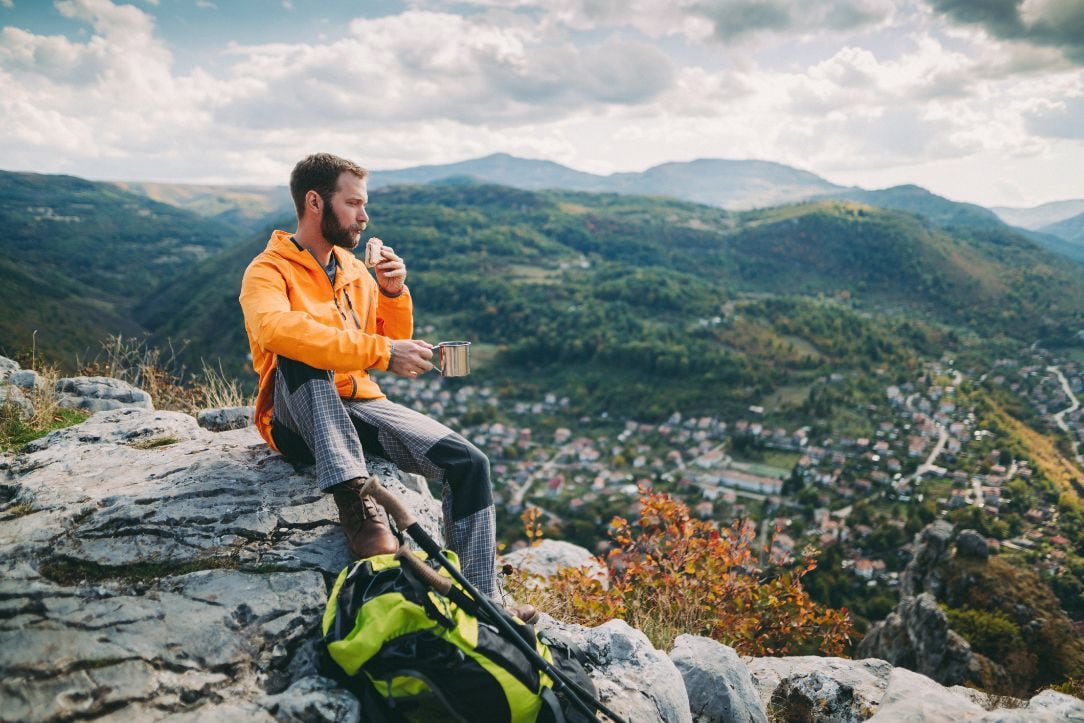
Cheese sandwiches are often the staple lunch option for me. I love to take Mini Cheddars or rice cakes to have alongside and finish off with some fruit and a flapjack. Nothing beats stopping for lunch in a beautiful place on the side of a mountain and having a 'scenic sandwich'.
If you are active all day, your overall energy (calorie) requirements will increase, so you will need to eat more than usual. Boost your portion of carbohydrate at meals to help make up for this additional need.
Protein is more important when it comes to recovery - which I will cover later.
Test before you go
Trust me, there is nothing more disappointing than having a whole packet of a food that you realise you do not like mid-way through a hike. So test these foods out in advance. This can be fun. We're asking you to eat a bunch of snacks.
Is it actually something that you will reach for three days into an adventure, or just the only thing the shop you're in had? One of the biggest mistakes I often see is people taking what they think they should, rather than what they'd actually like.
Another key test is to think about durability. What is going to withstand being bounced around and squished in your bag while hiking or cycling? Flapjack and cereal bars are great for durability. Sweets and chocolate hold up well too. But foods like crisps and some cakes, on the other hand, are not so good as they just crumble into nothing after a few days. Think tasty and think resilient.
Are you going to a hot or cold country?
Depending on where exactly you adventure is, you may need to consider the effect of the temperature on your food choices.
If you are going to a hot country then be mindful of food that is likely to melt. We've all been there. Chocolate can be a nightmare. You stick it in your pack and by the time it comes back out, it's been liquidised. My top tip is bringing Minstrels, because they do not melt. I can personally vouch for this as they withstood several days in the desert in Jordan with me.
Being mindful of fresh food and how long this will last is also important. For example, using spreads (jam, PB, honey) in sandwiches rather than cheese or ham. Most people know this, but what some forget is that the cold can affect food just as much. Things can become more difficult to eat and very hard - for example a big block of chocolate may be difficult, but a chocolate coated raison may work well.
Test out foods by putting them in the freezer and trying them straight from there. I can highly recommend shortbread! Another tip is to rewrap your food in tin foil. It's much easier to open if you have gloves on, or decant into zip lock bags.
Be prepared: advanced fuelling

The day before you go on an adventure is also important. Do ensure that you have regular meals and snacks across the day to top up your energy levels. This is to ensure that your ‘battery’ is full and you have the best energy. Prioritise meals, make sure your bag is packed and ensure that you take time to rest.
If it is possible, try to find out what food will be available on the trip (if it's a Much Better Adventures trip, see the Food & Accomodation tab on each trip page). Will you have access to shops or restaurants on the way? What type of food will be served? This will help you gauge how much you need to pack yourself.
Proactive fuelling
Whilst you are exercising, the key is to ‘eat before you need to eat’ and ‘drink before you need to drink’. Being proactive and will help you to maintain your energy levels, rather than playing catch up when they dip. This means you should start fuelling within the first hour of the activity, and regularly thereafter.
Being proactive and will help you to maintain your energy levels, rather than playing catch up when they dip.
Especially if you are on a cycling trip, this can happen easily as these are often at higher intensity. If you are like me, and eating whilst trying to stay upright on a bike is not the easiest task, then putting a carbohydrate drink in one of your water bottles can be a good way to fuel and hydrate at the same time. There are lots of great options available - from sports drinks like Lucozade Sport to carbohydrate powders like Tailwind or Styrkr. Even fizzy drinks can be good in a pinch, if you don't have any other options. Usually on any adventure, there are at least some stops where you can snack (and restock supplies) for going onwards.
Lightweight options
For obvious reasons, it is important to go lightweight but energy dense with your food. Nuts and nut butter can be great options here. Avoid using light/low fat options for fuelling as this will probably just mean you end up needing to carry more. Dried fruit is also great; a good source of energy, compact and light.
Hydration
Hydration is often a forgotten part of nutrition and performance. But it's very important. The simplest way to monitor your hydration status is by looking at your urine. You are aiming for a pale straw colour, anything darker than this and you are dehydrated. Keep your water easily accessible and sip away. Electrolytes will only be needed if you are exercising at high intensity, or heavily sweating.
Recovery
After a long day’s adventure ensuring you optimise your recovery is going to be key for multi-day adventure. Focus on the 4 R’s:
- Refuel: make sure you choose a high carb snack and make sure you have at least one source of carbohydrate at mealtimes.
- Repair: get a good amount of protein in to help your muscles heal after a long day on the trails. Beef jerky, nuts, Greek yoghurt and protein shakes can all be great options here.
- Rehydrate: top up your hydration to improve that recovery.
- Rest: don’t forget the importance of good sleep!
Stuart Kenny
One of my firm favourites for recovery is chocolate milk. If you are out in the wild, you can even make your own with chocolate powder and skimmed milk powder - and mix with water! Or beef jerky and crisps/crackers. These are both perfect combinations of protein and carbohydrate, which help you easily hit the refuel and repair aspects of recovery.
That's a lot of information, right? So, to summarise, here are my top tips:
- Preparation is key: take what you like and ensure you have sufficient fuel for the adventure.
- Be proactive with your fuelling: don’t leave it till you are hungry and thirsty, that is too late, keep the battery topped up!
- Check the weather and choose snacks appropriately.
- Remember carbs are key here for energy, but you will also likely need to eat more than usual to fuel your body.
- Eat snacks and enjoy the adventure!
Inspired? Check out our full range of adventure holidays now!