
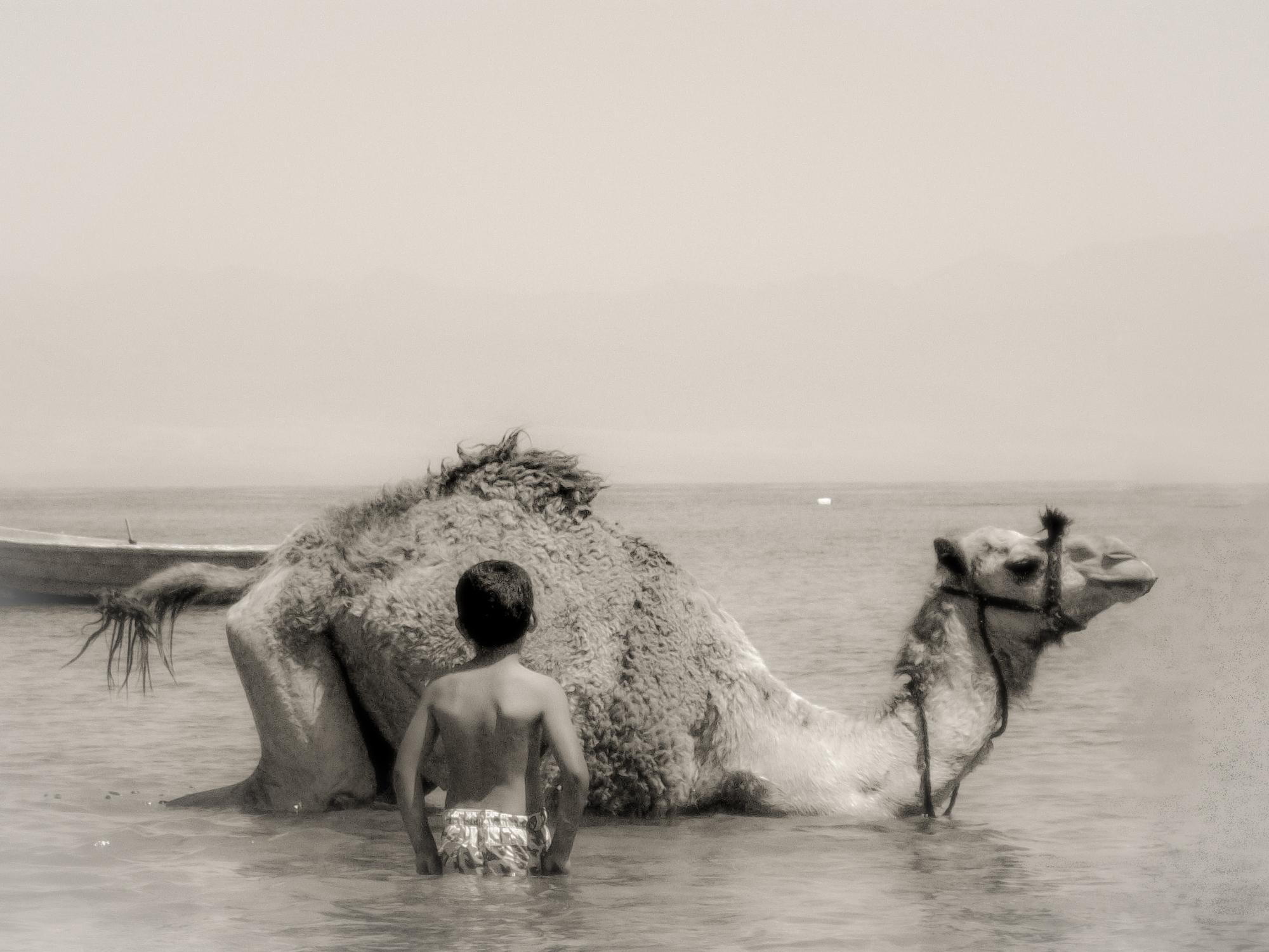
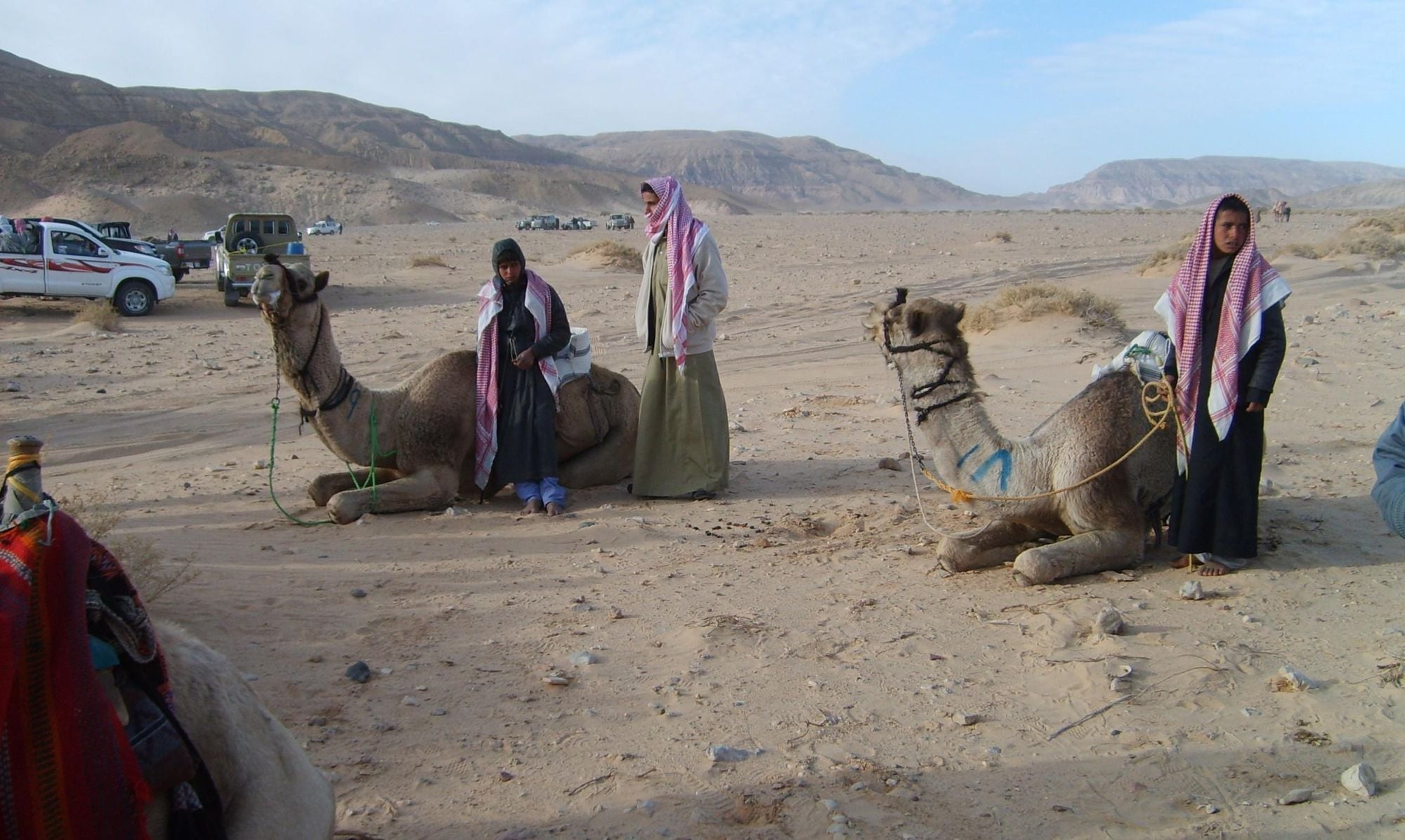
Did you know camels take baths? I expected to learn a lot when I moved to South Sinai in Egypt for academic research to live with a Bedouin community near Nuweiba' for two years. Camel bathing still came as a surprise.
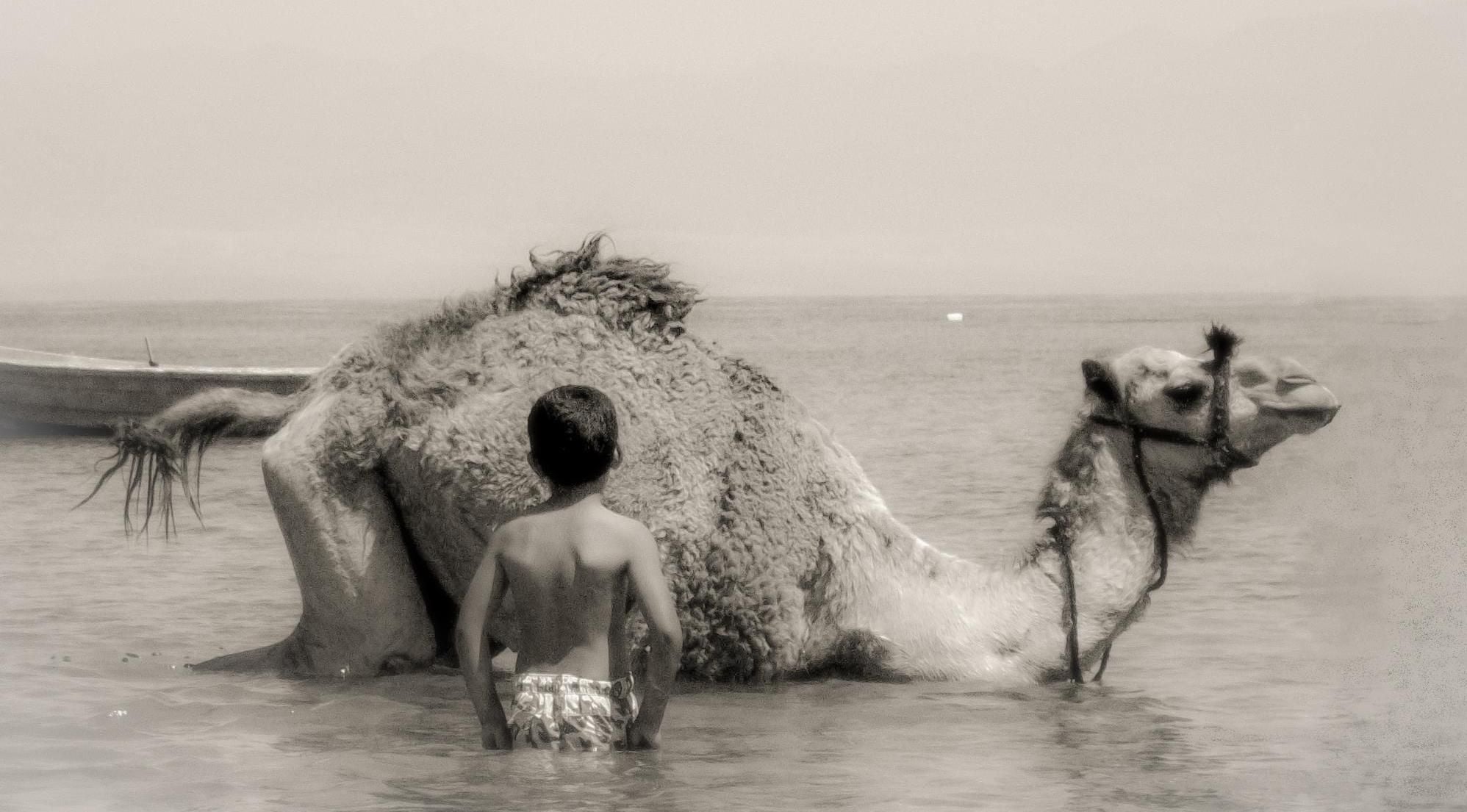
Golden-haired Bakraj the camel had escaped with his cousin for a desert adventure and they were retrieved covered in dudu. These beetle-type insects don’t like salt water, so I joined the owner and some local children as they led Bakraj to the edge of the sea. He was grumbling while he lumbered to his knees in the shallows. We waded out, sinking our hands wrist-deep into his coat to hunt for interlopers. Despite the constant guttural commentary I think Bakraj was secretly enjoying the attention.
My days on the coast were spent practising the dialect, swimming alongside manta rays and moray eels, and drinking tea with artists, actors and revolutionaries from Cairo.
When I first arrived in Sinai I lived in the village of Tarrabin, where a few hundred houses scatter down a slope of red earth between the mountains and the turquoise Gulf of Aqaba. Later, as the heat intensified, I moved to a bamboo husha in a nearby Bedouin-owned tourist camp on the beach. My days on the coast were spent practising the dialect, swimming alongside manta rays and moray eels, and drinking tea with artists, actors and revolutionaries from Cairo. Back in the village I danced in precarious high heels with Bedouin women friends at wedding celebrations under vast canvas tents, occasionally milked goats, and joined community events as often as I was invited.
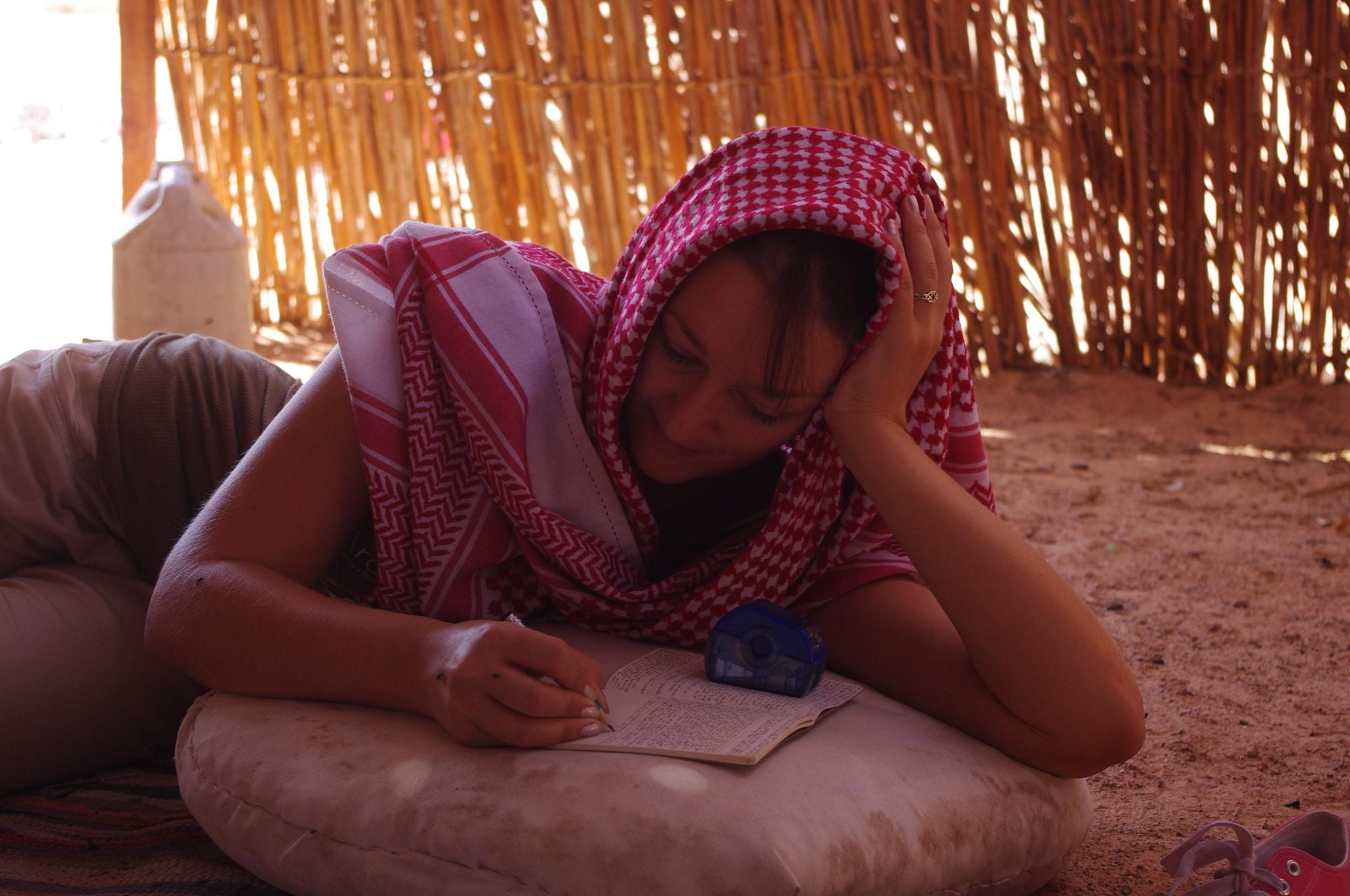
Even after years of adventurous travel, I was disturbed to find that I carried expectations about Bedouin culture. These cultural stereotypes have developed in most of us through centuries of exposure to paintings, books and films perpetuating a specific image of Bedouin life. Think Lawrence of Arabia. Commonplace images suggest that Bedouin are nomadic, live in tents in the desert, and women are repressed. At their worst the stereotypes indicate danger, dirt and ignorance. Whilst some images may originally have had some basis in fact, most are reductive and out-of-date.
 Much Better Adventures
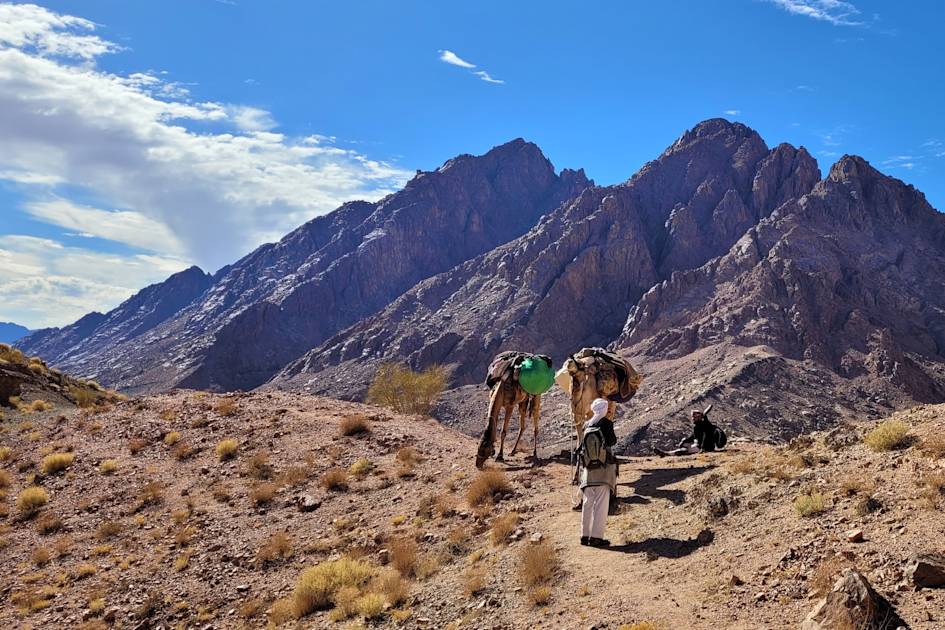
There are hundreds of Bedouin communities across the SWANA region (South West Asia and North Africa) and their cultures are not homogenous. Each community has evolved to reflect a multiplicity of environmental, social, and political influences.
There are some shared traditions, such as baking libbe flat bread in the ashes of the fire, not sitting with the soles of your feet towards another person, and methods of styling the red-and-white checked shmagh headdress, yet across the communities there is great diversity and nuance. No Bedouin community has ever been nomadic in the sense of being rootless wanderers, as T.E. Lawrence liked to claim. Although the majority now live in houses, a few still practice transhumance, rotating livestock seasonally between fixed grazing locations. Boundaries of land ownership have always been clearly defined, often by natural markers such as flood plains or rocks. Gender roles vary just as much. Some families resist education for girls beyond school age, whilst others support women to be members of the Egyptian parliament. The point being that relying on one stereotyped version of Bedouin life just doesn’t work.
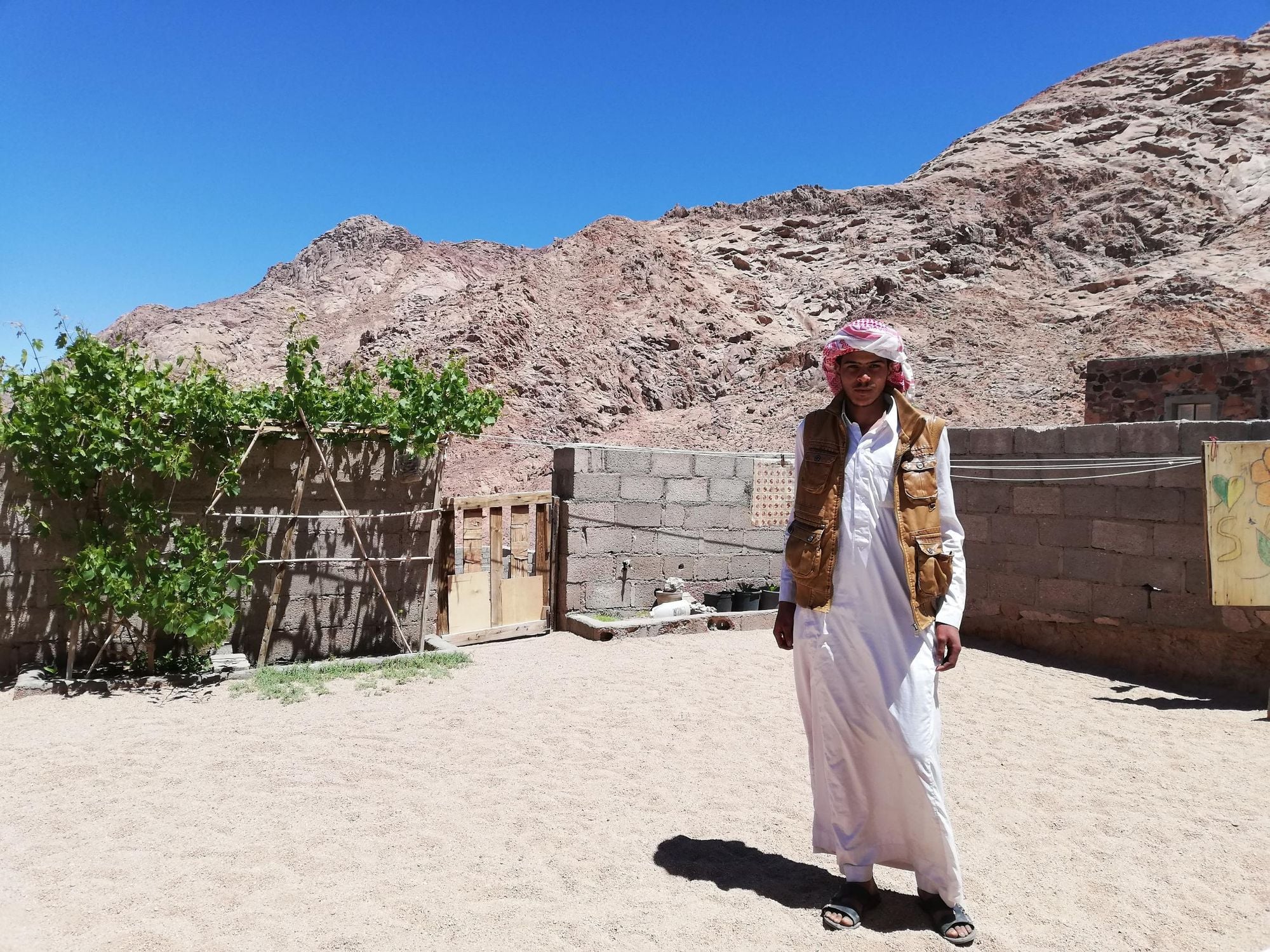
Early in my stay I was invited to visit ‘S’ in her breezeblock house with garden, washing machine, satellite television, fridge and running water. In Tarrabin it is disrespectful to use a woman’s name outside her immediate family, so I have used her initial here instead. ‘S’ and I became close friends over the years and spent many hours together watching Arabic-dubbed Bollywood films, and Msalsal Bedui – period soap operas based on Bedouin legends of love and warfare.
Although in one sense this gives communities agency over preserving their own culture, some locals mourn the loss of traditional knowledge for the next generations.
Many Bedouin people are proud of their history and traditions but at the same time choose to enjoy the comforts of housing and trucks in their daily lives. Choosing to embrace running water or technology does not have to mean abandoning traditions and can comfortably co-exist. I once joined a tourist trip into the desert and at dinner around the fire a European visitor began expressing how natural the chicken tasted, imagining it to have been freshly killed just for her trip. It had been bought that afternoon, frozen, plastic-wrapped and imported from Brazil before being enclosed in foil and buried under the ashes to cook. No-one broke the illusion for her, but we all smiled. Visitors want to return home with their Bedouin fantasy confirmed.
Much Better Adventures
Over time this can result in a sanitised caricature of traditional life. Although in one sense this gives communities agency over preserving their own culture, some locals mourn the loss of traditional knowledge for the next generations. Msellem Abu Farrag, brother of the Sheikh of Tarrabin, is one of many vocal advocates for young Bedouin joining the tourist trips into the desert so they can learn about their own heritage, whilst also sharing its importance with an international community. In the Jebelliya Bedouin community at the base of Mount Sinai, around fifty women and girls formed a cooperative called FanSina (Sinai artists) where they embroider clothing, bags and homeware with traditional designs that reflect the world around them. Their international success resulted in them being invited by artist Kirstie Macleod to work on The Red Dress, a ‘global collaborative embroidery project’. The largest commission was by the FanSina artists and, having discovered that we knew the same people in Sinai, Kirstie spoke with me about her experience of meeting Bedouin women in Sinai:
“My time in St. Catherine’s, in 2014 and again in 2023, revealed a community of deep identity and warmth where identity is not worn; it is lived. Today, as well as looking to the future, and certainly being affected by it, the women of Sinai remain rooted, honouring their culture with grace and resilience”.
Much Better Adventures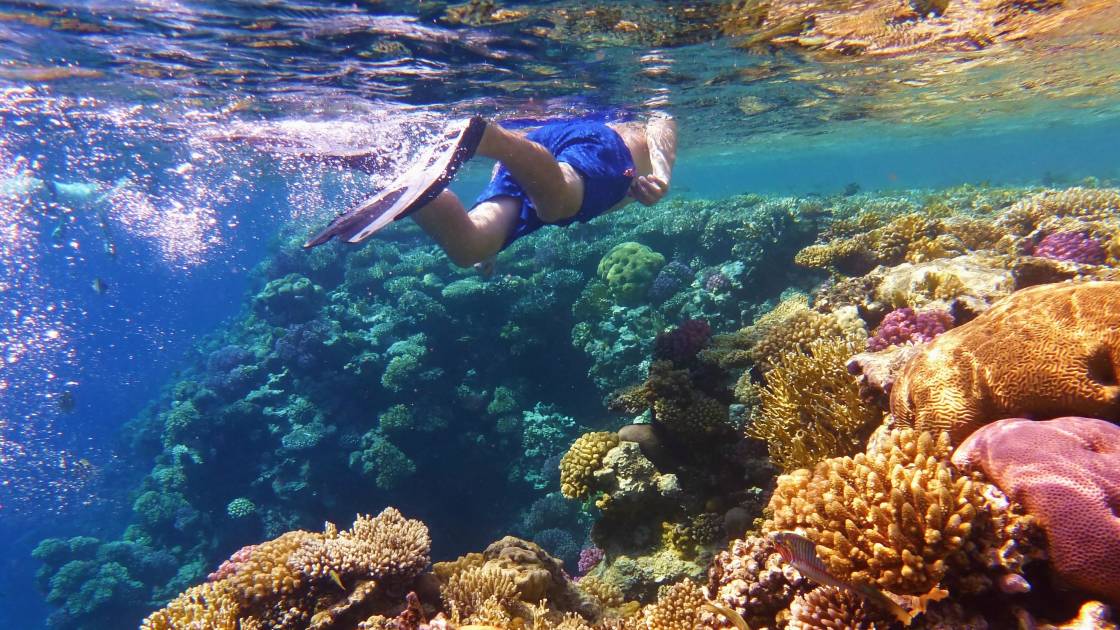
The impact of the FanSina extends out of the Jebelliya community now, with women from local villages coming to study embroidery techniques and trade items with the cooperative, in order to develop their own commerce with tourists at the beachfront resorts. 'A' has been running a smaller cooperative for women in Tarrabin, enabling women to support themselves through sales but also contribute to a money pool offering loans to fund emergency medical treatment or cover family expenses.
Spending time among the women in Sinai - and learning their language - enabled me to let go of my own inherited cultural stereotypes about Bedouin communities. I was able to experience the complexities of Tarrabani culture in far more depth, understand the community better, show more respect for my privileged position as a visitor, and ultimately form stronger friendships. I’ve been visiting now for more than 15 years and still feel that I know very little about Bedouin life, but I am humbled to be welcomed in the community and to learn more every time I visit.
Inspired? Check out our adventure holidays in Egypt now!