

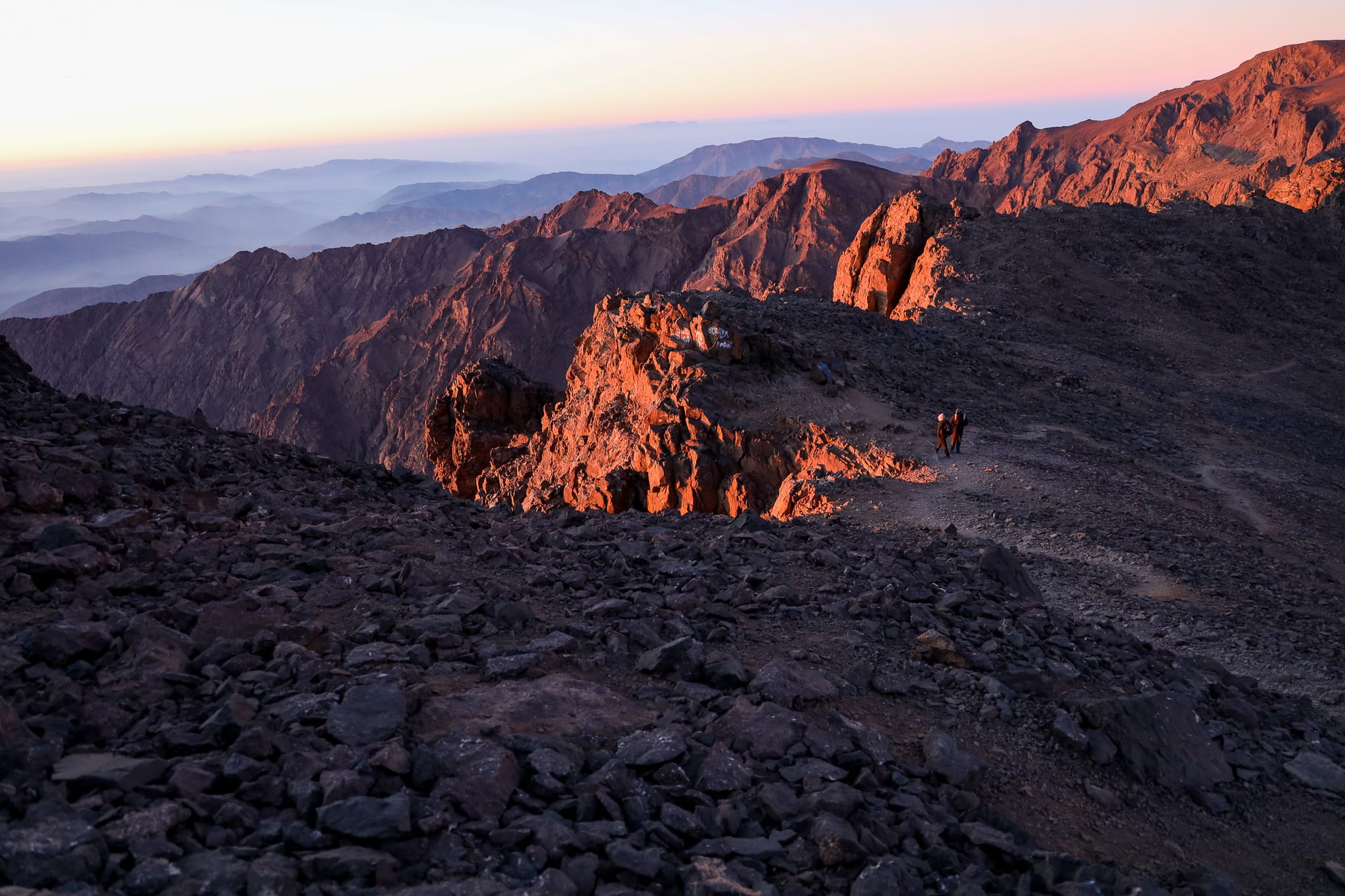
The best time to climb Mount Toubkal is, of course, a little subjective. Things like what kind of climber you are and what type of experience you’re craving means there’s more than one way to answer the question. As a rule of thumb, though, the best time to climb Toubkal is spring and autumn for trekking, summer if warm weather and clear summits are what you’re after, and winter for an ice axe and crampons ascent. Before taking on the mountain yourself, be sure to check out our full guide to climbing Toubkal first.
 Much Better Adventures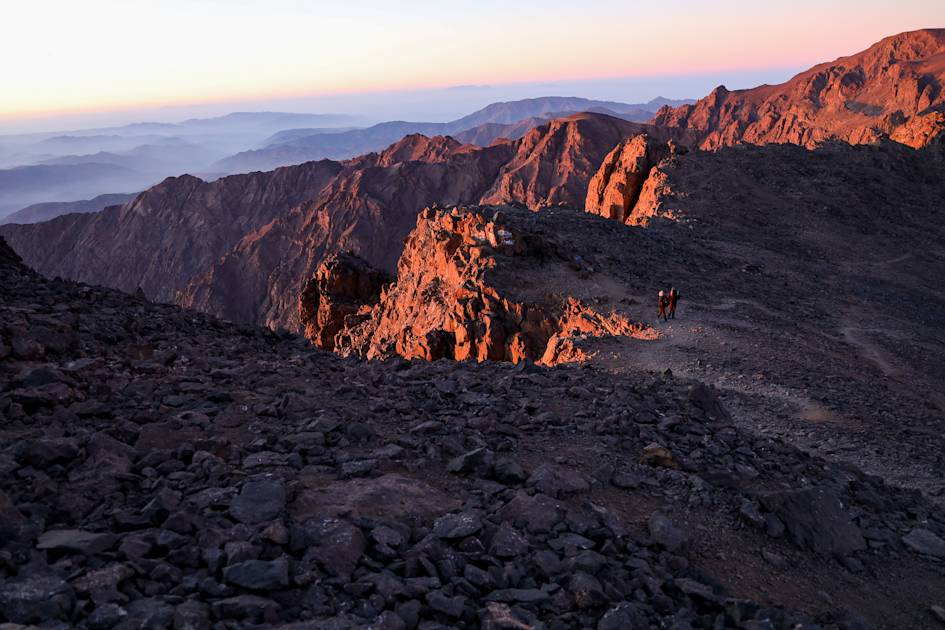
Mount Toubkal weather, month by month
The weather on Mount Toubkal changes significantly across the year, altering not just the air around you but the terrain itself. A climber who reaches the summit of the highest mountain in North Africa in December or January will experience something very different to the climber who gets up there in the height of summer. While those who tackle the climb in the traditional shoulder seasons will find themselves sampling something in between the two extremes. How difficult the ascent of Toubkal is will also depend on when you go - and that weather.
Keep in mind, of course, that mountains don’t always adhere to the rigid structures of a table like the one above. What you’re looking at here are approximate daytime temperatures, based on typical weather patterns. Such information can serve as a useful guide, and a way of working out what you can expect on your adventure, but weather can stop a climb at any time. If you experience conditions on your climb so bad that your summit attempt has to be called off, just remember that your guide has your safety as a priority.
Summer temperature can be a reason to stop climbing Toubkal. And in the middle of winter, thick snow and wearing crampons can make it harder for people.
Never forget that with a summit 4,167m (13,671ft) above sea level, temperatures across your climb on Toubkal can vary significantly. A warm hike under the relentless beat of the midday North African sun will be nothing like what you’ll experience walking in the evening shade or resting at the mountain refuge overnight. On summit mornings as well, climbers tend to leave the refuge before dawn when things are considerably colder. Pack accordingly.
The best time to trek Toubkal
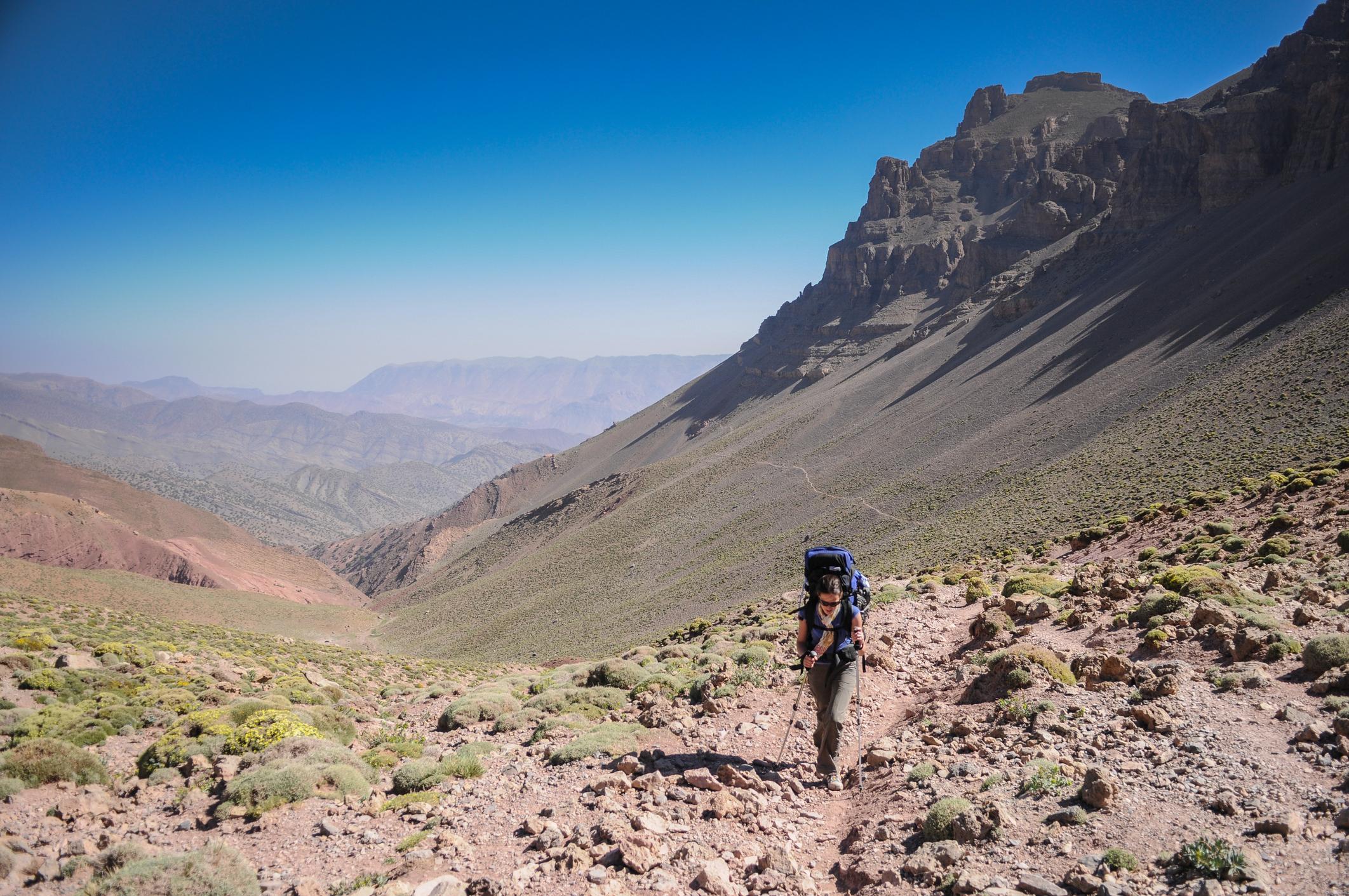
Generally speaking, spring and autumn are the best times to go trekking on Toubkal. For those contemplating what the different seasons on Toubkal offer, and which time of year best suits what they want in an Atlas Mountains adventure, we’ve broken down how the trekking experience here varies over a 12-month period below.
- Spring: Spring is one of two seasonal sweet spots for trekking on Toubkal, alongside autumn. The season brings with it stable and mild mountain weather. Across April and May, in particular, you’re climbing at a time of year when the freezing, high-risk winter ice is a memory and the extreme heat of summer has yet to arrive.
- Summer: At the height of summer on Toubkal, you’re going to be contending with some really intense heat. Invest in high-altitude sun protection including SPF 50+ sunscreen, sunglasses and a wide-brimmed sun hat before attempting the climb. Get moving early in the morning to avoid the most extreme weather, and drink plenty of water.
- Autumn: After the heat and crowds of summer, a time of year when the mountain is at its busiest, comes the relative calm of autumn. Much like climbing Toubkal in spring, this time of year offers stable weather conditions and pleasant daytime temperatures. Bear in mind, however, that September and October are more reliably dry and clear than November. The latter is no stranger to early snowfall and a generally more wintry feel.
- Winter: Climbing Toubkal in winter is a different beast entirely. The coldest season transforms North Africa’s highest peak into a proper high-altitude mountaineering experience. You’ll likely have to overcome deep snow, sub-zero temperatures and ice-covered ridges on your route to the summit. Ice axes and crampons at the ready.
Much Better Adventures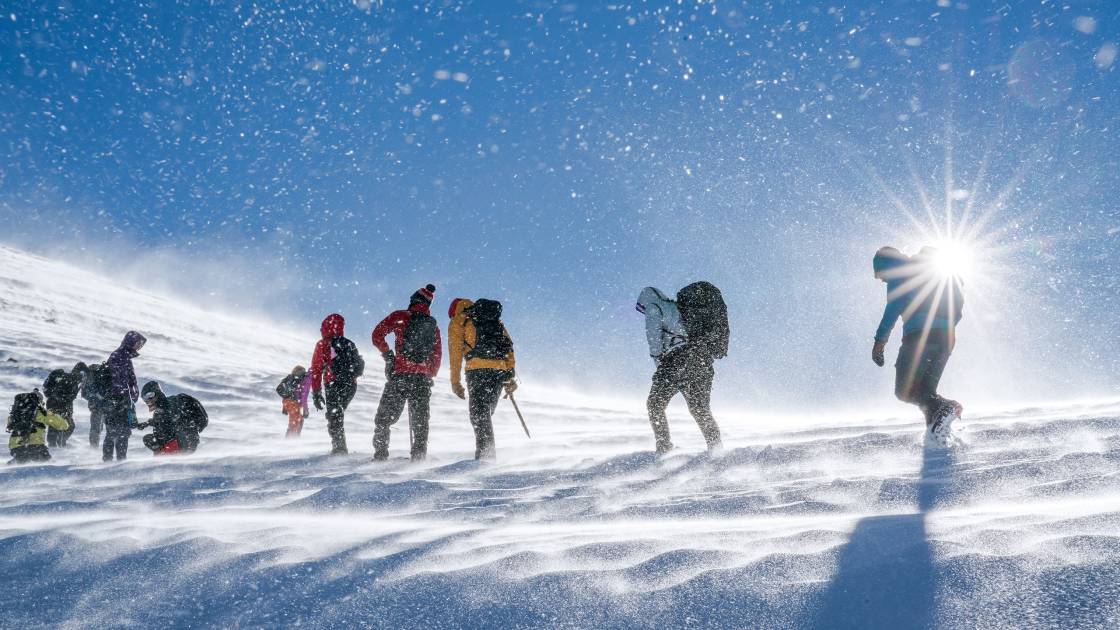
Mohamed Aztat, aged 46, has experienced everything Toubkal has to offer on the weather front. An independent Berber tour operator based in Imlil and Marrakech, and a partner of Much Better Adventures, he has summited the mountain more than 180 times since his first successful climb at the age of 13. When it comes to the wildly different conditions the Atlas range can serve up, he’s seen it all.
“In spring, like April, May, and in September, October, this can be the best of both worlds,” he tells me. “I prefer it. The weather is more stable. The temperature is not so intense. Summer temperature can be a reason to stop climbing Toubkal. And in the middle of winter, thick snow and wearing crampons can make it harder for people. The freezing cold can stop people.”
Climbing Toubkal in winter
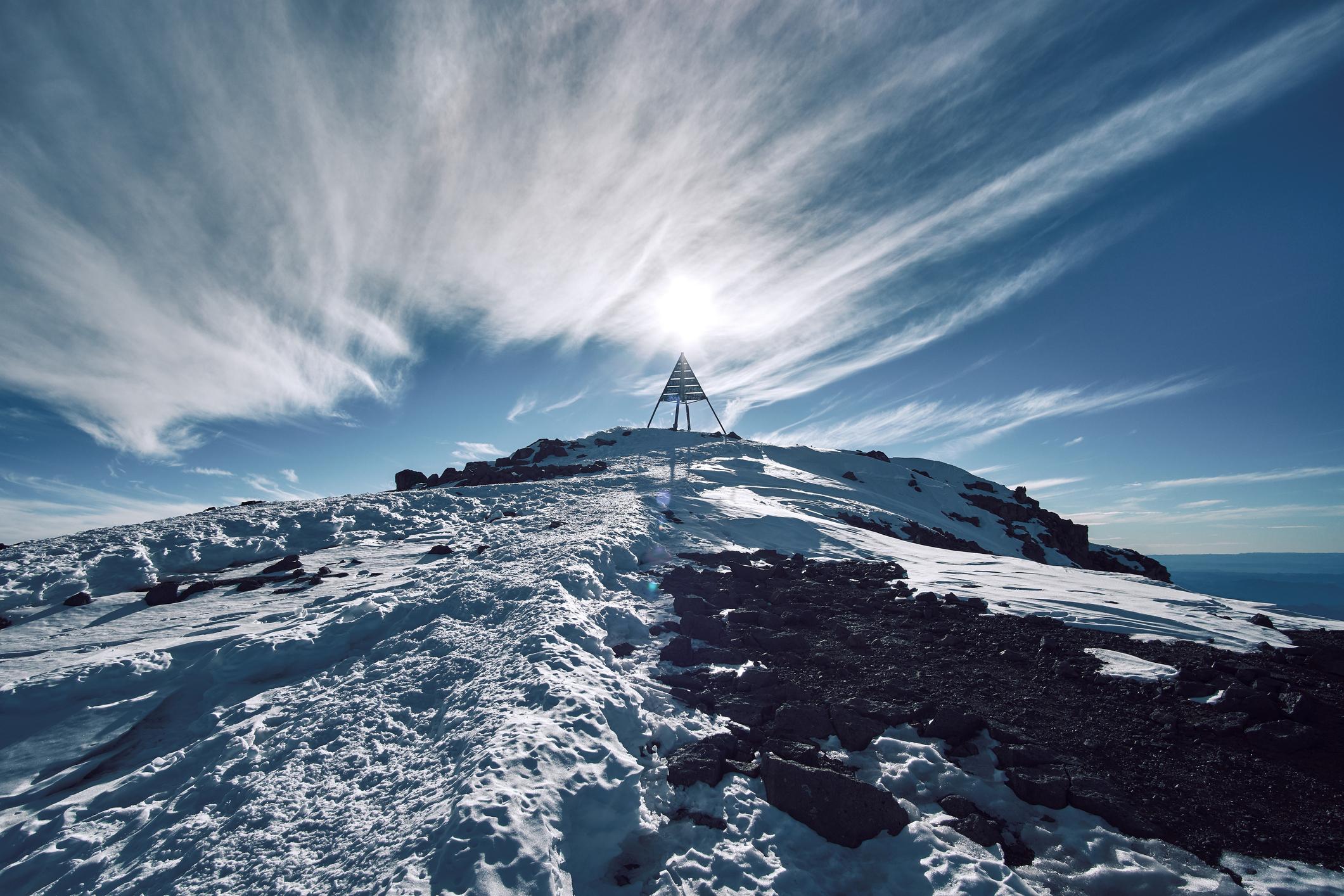
In the cold months of winter, climbing Toubkal hits a whole new level of difficulty. Intrepid climbers looking to meet this genuine mountaineering challenge head-on should brace themselves for hip-deep snow, hazardous ice and sub-zero temperatures en route. Faced with the prospect of windchill well into the minuses up at the summit, acquiring some warm, technical winter clothing beforehand is clearly an absolute must. Winter climbers of Toubkal have, over the years, also noted the importance of taking a well-insulated sleeping bag and packing a thermos flask rather than a hydration bladder.
It can be freezing cold and it can be tough working with the crampons and the axes.
To reach the summit of Toubkal in winter, you’ll need to wear crampons and learn how to wield an ice axe at high altitude. Book onto a trip with Much Better Adventures and you’ll see that the itinerary for our winter Toubkal ascent gives over an entire day to acclimatisation and equipment training. Trying out your crampons and ice axe on some of the lower peaks around Toubkal’s mountain refuge (3,207m/10,521ft), your guide will ensure you’re well versed in the specialist gear needed to make a successful winter summit.
 Sian Lewis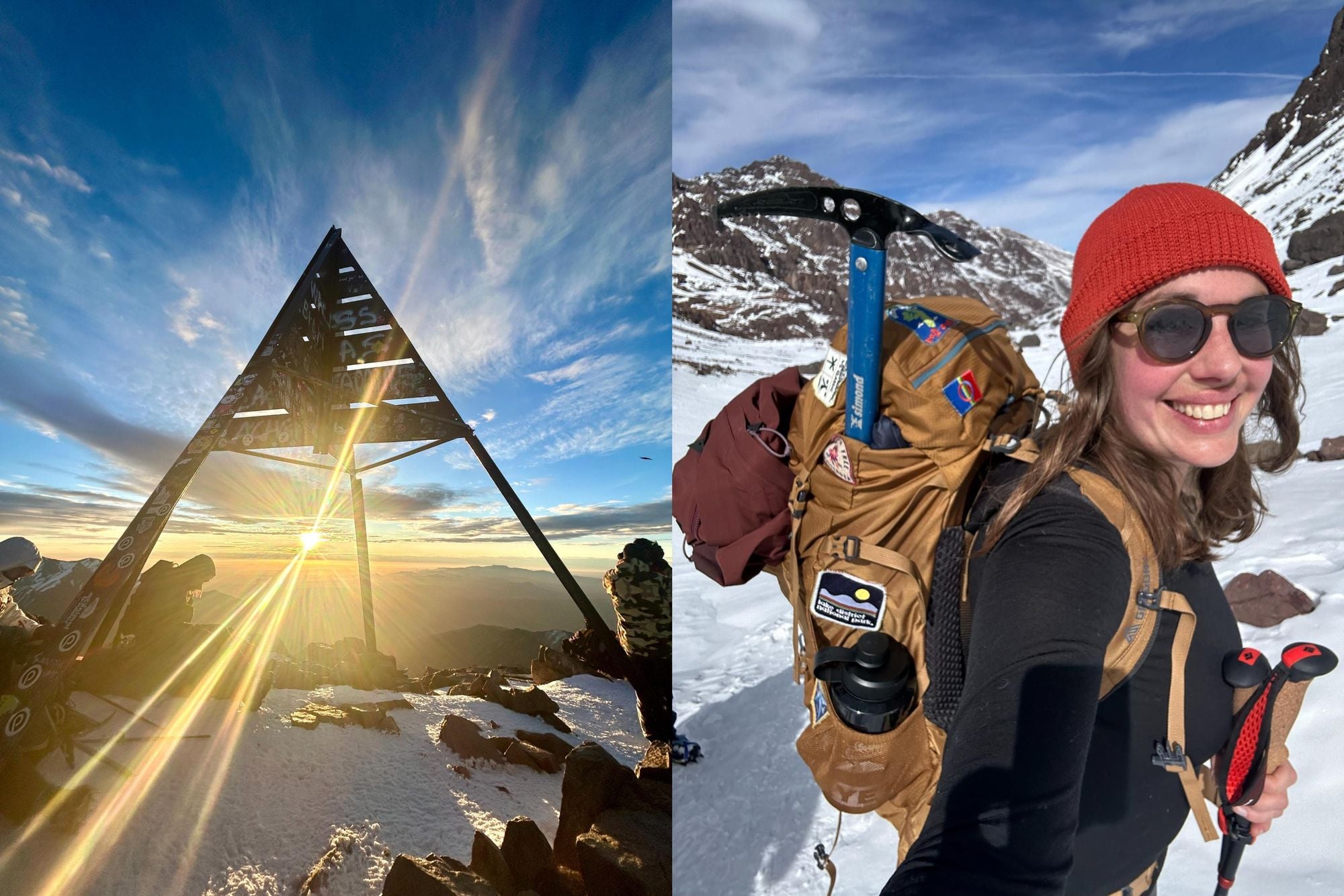
Even with a day given over to crampons and ice axe training, and with the expert eyes of your mountain guide keeping a sharp and safety-first eye on weather conditions and avalanche risk, nobody should be under any illusion that climbing Toubkal in winter doesn’t represent a far more significant challenge. Your guide can provide you with crampons and ice axes, and give you pointers on how to use this specialist mountaineering equipment, but they can’t battle through the snow and ice on your behalf. You’ll need to work hard.
“It’s like climbing Mont Blanc. You need really good gear to be able to make it up Toubkal when it’s cold,” says Mohamed. “It can be freezing cold and it can be tough working with the crampons and the axes.”
When to avoid climbing Toubkal
There’s no right or wrong time to climb Toubkal. That being said, there’s no point sugarcoating how brutal the peak-summer midday heat can be. If you hate the idea of exerting yourself when that burning ball of fire in the sky is at its most merciless, give climbing Toubkal between June and August an almighty swerve. At the other end of things, there’s equally nothing to be gained from pretending that climbing Toubkal at the coldest time of year will appeal to those with zero appetite for winter mountaineering.
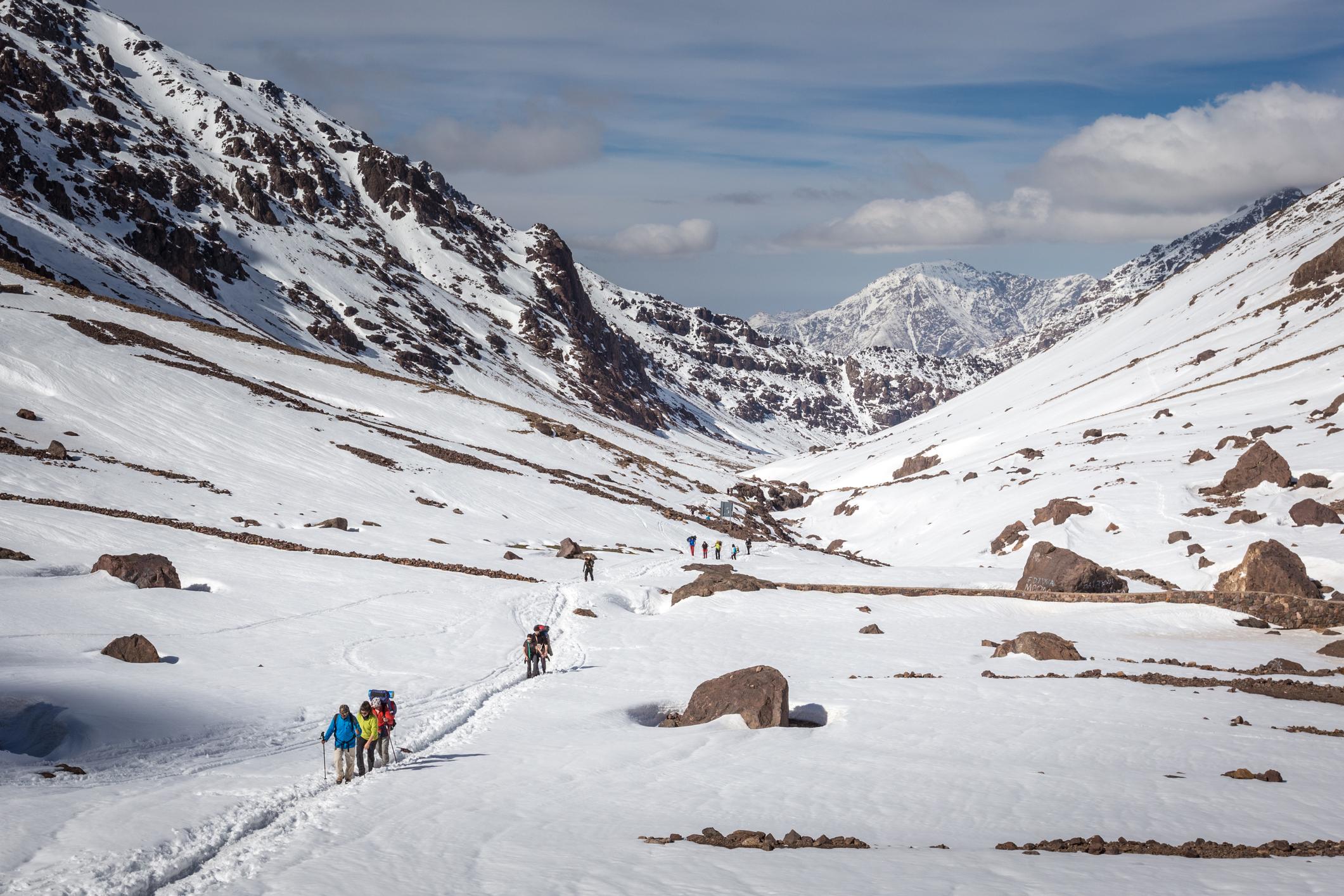
This isn’t to say that climbing Toubkal in winter, or summer for that matter, isn’t without its charms. Summer climbs will be hotter, for sure, but they’ll also be far more likely to serve up clear blue skies when you’re up at the summit. And on the flipside, winter climbs may be tougher but that increased level of challenge arguably offers a greater sense of reward for those who make the ascent. The fact the mountain will be far less busy, too, means you won’t have to share Toubkal with crowds of tourists either.
Much Better Adventures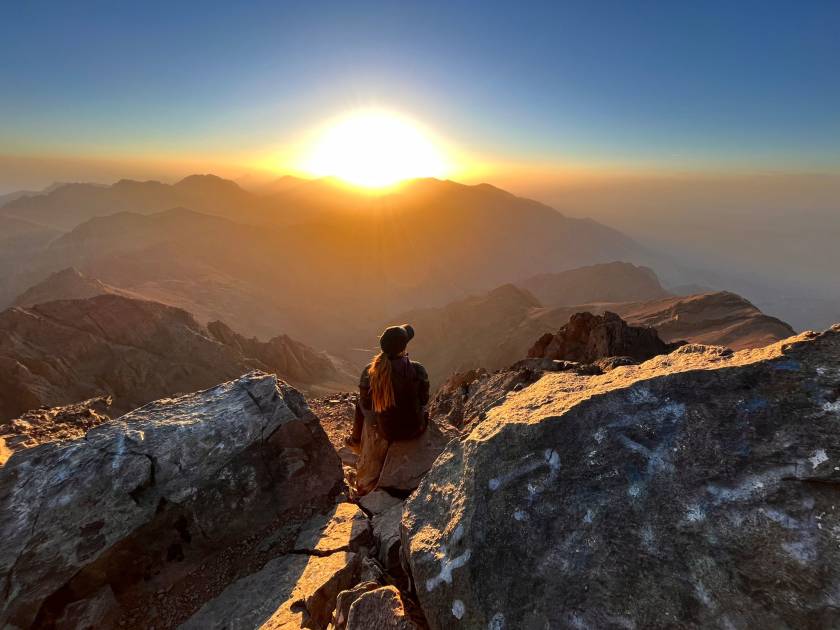
When planning your Toubkal trip, it’s worth remembering that Morocco is a Muslim country. During Ramadan celebrations, which move forward by roughly 10 to 12 days every year, Muslims are required to abstain from all food and drink between dawn and sunset. Guided tours of Toubkal will still take place during this time, but it’s important to note that treks may move at a deliberately slower pace so the teams looking after you can better manage their energy levels. Tourists and non-Muslims are not expected to fast, and you should eat and drink as normal. Cultural respect, though, is paramount.
It’s like climbing Mont Blanc. You need really good gear to be able to make it up Toubkal when it’s cold. It can be freezing cold and it can be tough working with the crampons and the axes.
For more information on how hard the climb really is, and which time of year would best suit both your preferences and expertise, read out our further guides.
FAQs
What is the weather like on Mount Toubkal?
Asking what the weather is like on Toubkal is the equivalent of asking someone how long a piece of string is. It’s a question with an almost infinite array of answers. Depending on what time of year it is, and even where on the mountain you’re discussing, the conditions can vary greatly.
Down in the Imlil Valley, which is where Toubkal climbs usually begin, you’re looking at summer daytime temperatures anywhere between 20°C (68°F) and 30°C (86°F). As you make your ascent up to the mountain refuge, temperatures tend to drop by about 10°C (50°F). Up at the summit, you can expect a further temperature drop of between 5°C (41°F) and 10°C (50°F), depending on what time of day you’re making your final push. Across summer, you can expect clear skies, dry forecasts and the most stable of weather conditions.
From valley to summit, Toubkal gets considerably more arctic in winter. Climbers on the summit, for example, might have to contend with summit temperatures dropping to as low as −10°C (14°F). And with strong and icy winds coming into play, the windchill has been known to make this feel even more sub-zero. In addition to being battered by bitterly cold winds, winter climbers should also be prepared for heavy snowfall and dramatic weather shifts. Clear skies suddenly turning into severe blizzards is par for the course.
Can you climb Mount Toubkal in winter?
Yes, you can climb Toubkal in winter but only with crampons, an ice axe and the expert knowledge of a guide helping you. If you want an easier climb up the highest mountain in North Africa, choose a different season to travel. If, however, you love the idea of some cold-weather mountaineering in Morocco, consider booking yourself a spot on one of our winter Toubkal climbs.
Sian LewisIs there snow on Mount Toubkal in summer?
No, there isn’t much in the way of summertime snow on Toubkal. The standard hiking routes will often be completely free of snow and ice, meaning you won’t need technical winter gear like crampons and ice axes to make a successful summit. You may spot leftover winter snow in some shaded and isolated patches high up but it’s unlikely to affect your ascent in any meaningful way. Near the summit, temperatures – even in summer – are noticeably cooler than they are in Imlil and Marrakech so pack accordingly.
When is the best time to climb Mount Toubkal?
The best time to climb Toubkal is in the shoulder seasons. Spring and autumn is when the weather conditions here are at their most stable, mild and predictable. In April and May, you’ll have the chance to gaze upon blooming wildflowers in the beautiful lower valleys. While in September and October, thought by many to be the best period to climb, the tourist crowds have vanished, leaving behind dry and well-trodden trails.
Climb Toubkal in the right season with us
Whatever kind of Toubkal climbing experience you’re after, you can find it with Much Better Adventures. Whether you want to climb Mount Toubkal in a weekend or extend your stay with a sleep in the Sahara, we’ve got trips to suit all preferences. Our Mount Toubkal trips run throughout the year, meaning you’re free to follow your heart’s desire across the seasons – and changing conditions.
Fancy a week trekking in the Atlas Range? Have a look at our five-night Toubkal climb, with its acclimatisation in the foothills and generally more circular route. Think you’ve got what it takes to climb the mountain at its coldest and most unforgiving? Bag yourself a spot on one of our winter climbing trips up Toubkal.
Inspired? Browse our full range of adventures in Morocco now!